Chapter/Index: Introduction | A | B | C | D | E | F | G | H | I | J | K | L | M | N | O | P | Q | R | S | T | U | V | W | X | Y | Z | Appendix
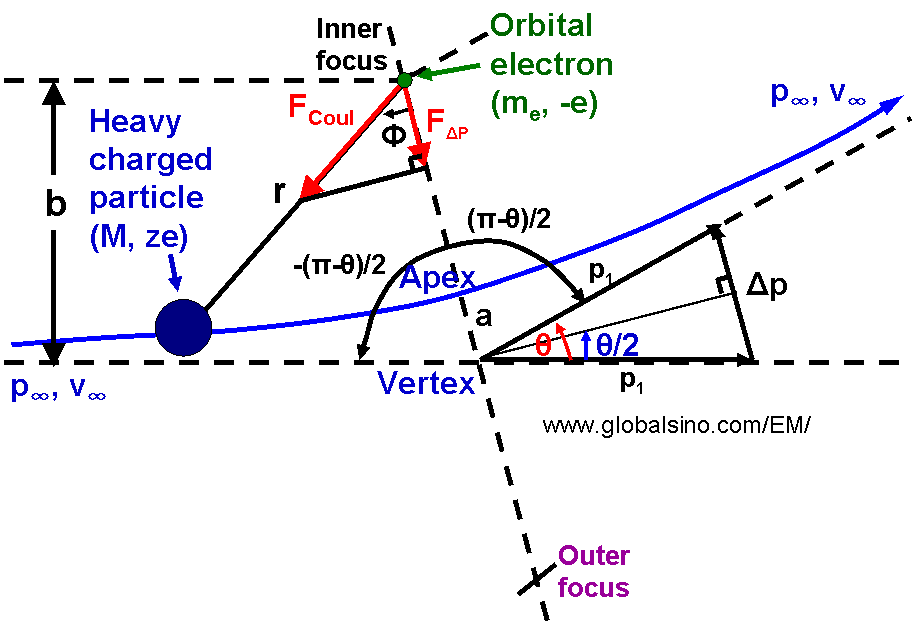
| It is different from Rutherford scattering that has mα (α particle) << M (gold nucleus), the situation here is that a heavy charged particle M interacts with an orbital electron me (M >> me). Figure 4418 shows the Coulomb interaction between the heavy charged particle (charge ze and mass M) and the orbital electron (charge e and mass me).
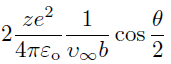
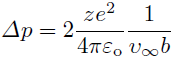
Figure 4418. Schematic diagram of a collision between a heavy charged particle M and an orbital electron me. Using the conservation of angular momentum, we can know the momentum transfer Δp can be given by, In the case of a heavy charged particle (ze) interacting with a stationary orbital electron (e) the scattering angle θ ≈ 0 and thus, Δp can be simplified by, The energy transferred to the orbital electron from the heavy charged particle for a single interaction with an impact parameter b is given by,
|

 --------------- [4418a]
  -------------------- [4418b]
 ---------------- [4418c]