Chapter/Index: Introduction | A | B | C | D | E | F | G | H | I | J | K | L | M | N | O | P | Q | R | S | T | U | V | W | X | Y | Z | Appendix
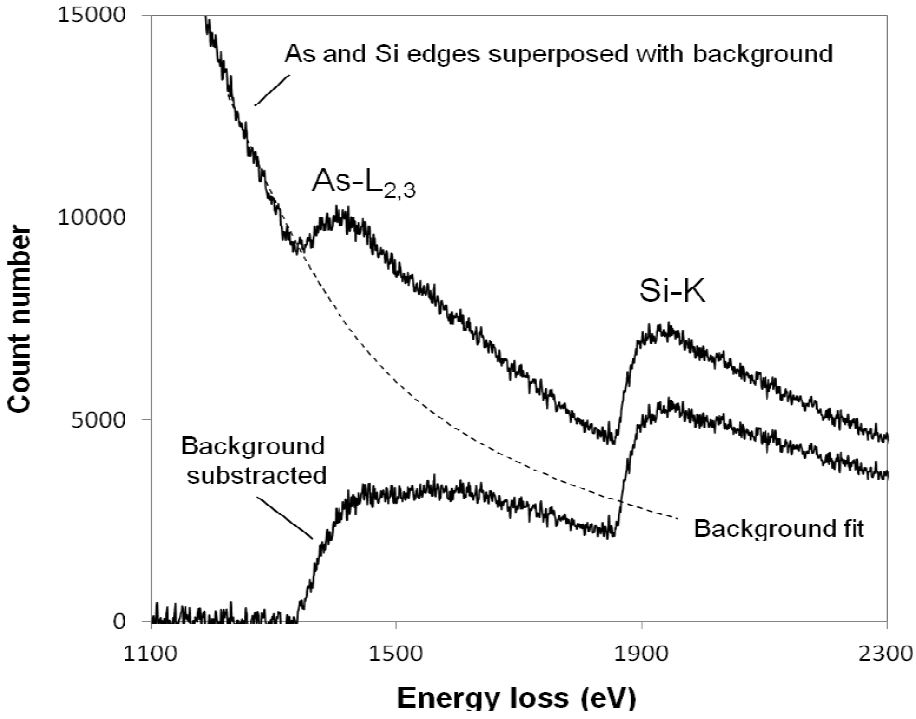
| Based on a non-relativistic theory, Allen and Rossouw [1] calculated the inelastic object functions for K-shell ionization. The calculated object functions for the K-shell excitations of some elements such as Te, Cd, As and Ga indicate that the localization of the object is less than 1 Å [2]. Figure 139a shows the As-L2,3 EELS spectrum, taken from a highly As-doped Si (silicon) crystal (3.7%, namely 1.85 × 2021 cm-3), before and after background extrapolation. The electron dose used for the data acquisition is 0.8 nA x 10 s at an accelerating voltage of 120 keV.
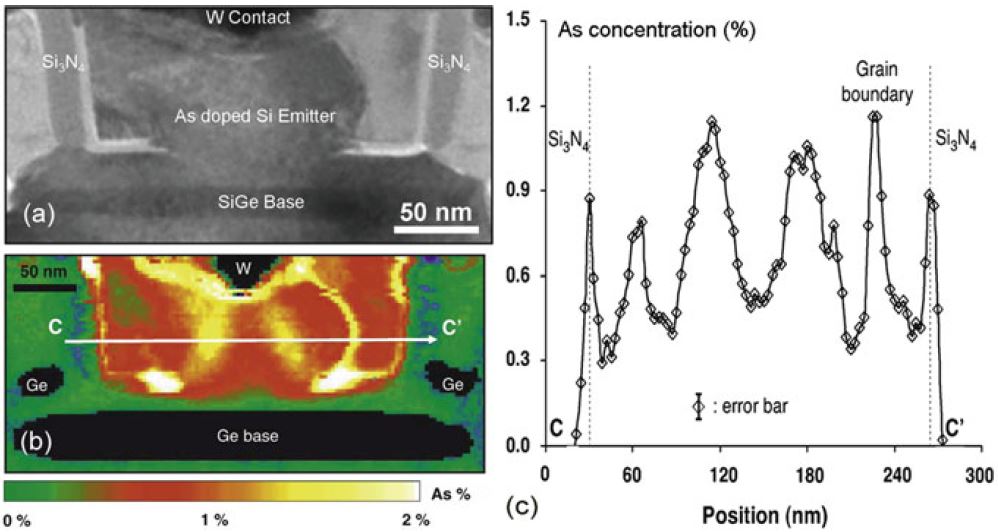
The background extraction window can be 150 eV in energy width (from 1,173 to 1,323 eV), and the signal integration windows can be 260 eV (1,323~1,583 eV) and 150 eV for the arsenic edge and silicon edge, respectively. [3] Figure 139b shows an As-L2,3 EELS map and a line scan of As-doped Si BiCMOS n-p-n transistors with As detection sensitivity of 1019 cm–3 at a spatial resolution of ~2 nm, measured in a STEM system with an incident beam energy of 120 keV.
|