|
||||||||
Flow of Tensor - Python for Integrated Circuits - - An Online Book - |
||||||||
| Python for Integrated Circuits http://www.globalsino.com/ICs/ | ||||||||
| Chapter/Index: Introduction | A | B | C | D | E | F | G | H | I | J | K | L | M | N | O | P | Q | R | S | T | U | V | W | X | Y | Z | Appendix | ||||||||
================================================================================= The flow is basically an
underlying graph computation framework that uses tensors for its
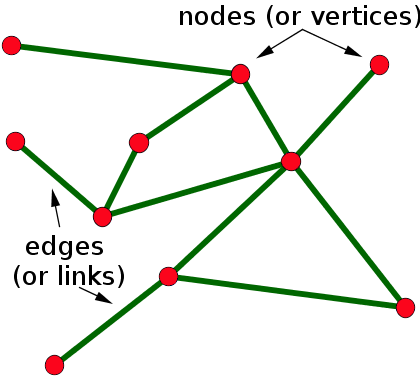
execution. A typical graph consists of two entities (as shown in Figure 4142a):
Figure 4142a. Typical graph with nodes and edges. The graph in Figure 4142a can normally be cyclic or acyclic. However, in
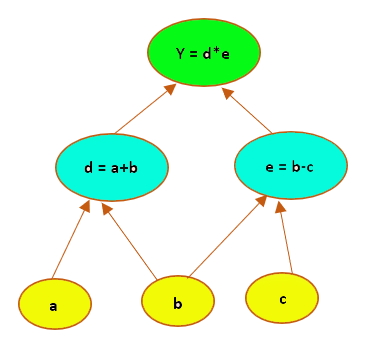
TensorFlow, it is always acyclic, that is, it cannot start and end at the same node. As shown in Figure 4142b, the tensors flow through the edges or connections
between nodes, and the computation at the next node results in formation
of new tensors, such as d and e in the figure, is created, as an output constant or variable, through
a computation at the node using other tensors a, b and c, and node Y, Y = (a + b) * (b-c), is created by using nodes (constant or variables) d and e. The nodes at the upper level become
the input for next-node computation flowing through edges. The nodes at the same level can be executed in parallel, as there is no
============================================
|
||||||||
| ================================================================================= | ||||||||
|
|
||||||||