Electron microscopy
 
std() and pstdev() standard deviation in csv
- Python for Integrated Circuits -
- An Online Book -
Python for Integrated Circuits                                                                                   http://www.globalsino.com/ICs/        


Chapter/Index: Introduction | A | B | C | D | E | F | G | H | I | J | K | L | M | N | O | P | Q | R | S | T | U | V | W | X | Y | Z | Appendix

=================================================================================

In Python, `stat.pstdev()` is a function from the `statistics` module used to calculate the population standard deviation of a dataset:

  • `statistics.pstdev(data)`: This function takes a list of numerical data points as input and returns the population standard deviation of the dataset. 

  •  Population standard deviation is a measure of the amount of variation or dispersion in a set of values. It quantifies the amount of variation or dispersion present in the dataset.

  •  The formula to calculate population standard deviation involves taking the square root of the variance, where variance is the average of the squared differences from the mean. 

  •  Unlike the `statistics.stdev()` function, which calculates the sample standard deviation, `statistics.pstdev()` calculates the population standard deviation, assuming that the provided data represents the entire population rather than a sample of it.  

While both functions, statistics.pstdev() from the statistics module and pd.Series.std() from the pandas library, calculate the standard deviation, there can be differences in their behavior and results depending on the data structures they operate on and their default parameters. 

Here are some key differences: 

  • Data Structure: statistics.

    1. pstdev(): This function operates on a Python list or tuple containing numerical data. 

    2. pd.Series.std(): This method operates on a pandas Series object, which is typically a column of a DataFrame but can also be a standalone Series. 

  • Default Behavior: 

    1. By default, statistics.pstdev() calculates the population standard deviation. 

    2. By default, pd.Series.std() calculates the sample standard deviation. To get the population standard deviation, you need to set the parameter ddof=0. 

  • Dependency: 

    1. statistics.pstdev() is part of the Python standard library statistics module. 

    2. pd.Series.std() is a method provided by the pandas library and depends on having pandas installed. 

============================================

Calculate the population standard deviation of a dataset.  code:


Output: 


============================================

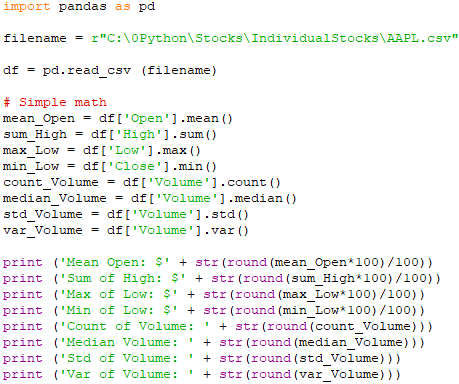
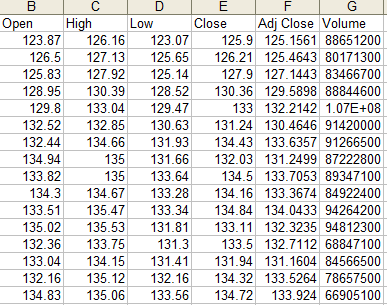
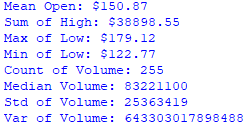
std() (standard deviation) in csv: code:
        Search with defined functions
Input:
         Search with defined functions
Output:
         Search with defined functions       


=================================================================================