Electron microscopy
 
Atomic Polarization
- Integrated Circuits and Materials -
- An Online Book -
Integrated Circuits and Materials                                                                                  http://www.globalsino.com/ICsAndMaterials/        


Chapter/Index: Introduction | A | B | C | D | E | F | G | H | I | J | K | L | M | N | O | P | Q | R | S | T | U | V | W | X | Y | Z | Appendix

=================================================================================

The polarization in materials can be due to several mechanisms: [1-7]
          i) Electronic polarization.
          ii) Ionic (molecular) polarization.
          iii) Atomic polarization.
          iv) Orientational (dipolar) polarization.
          v) Spontaneous polarization
          vi) Hopping polarization.
          vii) Space charge (interfacial) polarization.
          viii) Polarization created by hopping of charge carries between localized sites.

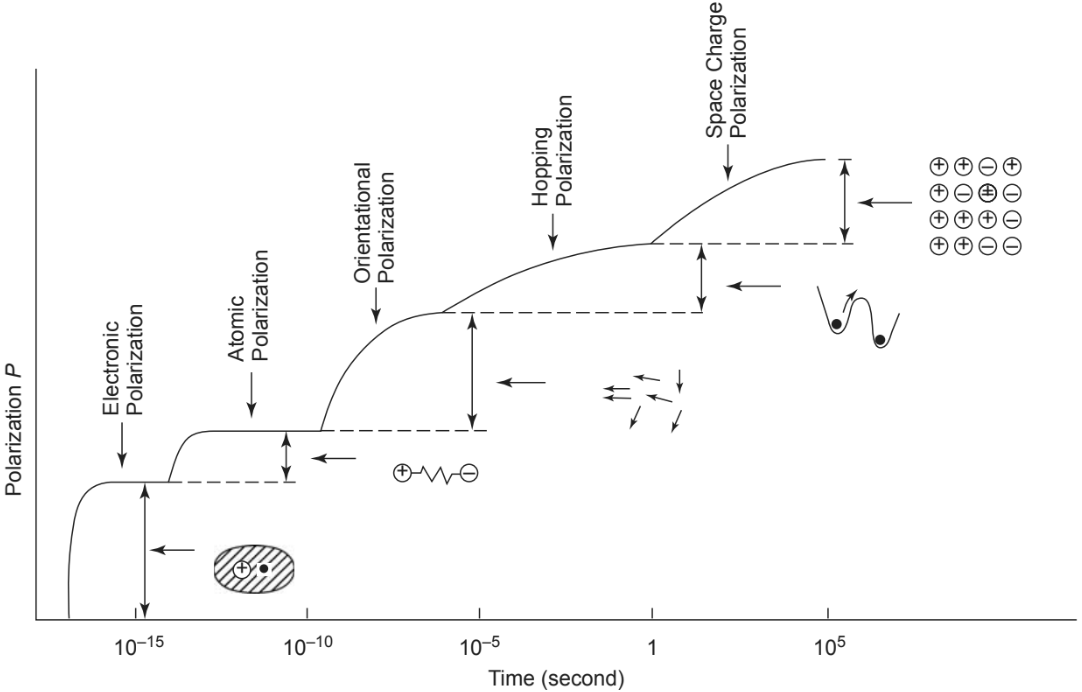
The mechanisms of electronic, ionic and atomic polarizations and depolarizations are much faster (<10-12 sec) than the others. This deformational polarization process is also referred to as the resonance process since it involves vibrating modes. The time required for orientational, hopping, or space charge polarization and depolarization is very long and varies in a wide range, depending on the dielectric systems; such polarization processes are sometimes referred to as relaxation processes because they involve a relaxation time. A relaxation phenomenon occurs when restoring action tends to bring the excited system back to its original equilibrium state. Depending on the time scale, the fast polarizations together can be considered as an instantaneous polarization P0. On the other hand, the polarization is to be finite at longer times, P(t →∞) = Ps, because an infinite amount of electrical energy cannot be stored in a dielectric (or a capacitor). [8] Figure 4553a shows the approximate time required for polarization.


Variation of different types of polarization with time under a step-function electric field F

Figure 4553a. Variation of different types of polarization with time under a step-function electric field F. [5]


============================================


[1] A. K. Jonscher, Diebtric Relnlnration in Solids. Vol. London, pp. Chelsea Dielectric, London, 1983.
[2] B. K. P Scaife, Principles of Dielecltics. Oxford Seience Publications, 1998.
[3] H. Frahlich, Tlirory of Dielectrics; pennittiuitynnd dielectric loss. Oxford Science Publications, Oxford, second edition, 1958.
[4] C. I. E BBttchei, Tlimry of Electric Polaflzntion. Elsevier Publishing COmpq Amierdam, 1952.
[5] Kwan Chi Kao, Dielectric Phenomena in Solids: With Emphasis on Physical Concepts of Electronic Processes, 2004.
[6] A. K. Jomcher, "The universal dielectric response and its physical significance", IEEE Traiani. on Elec. Insul., Vd 27, pp. 407123,1992.
[7] 1. C. Dyre and T. B. Schrodei, "Universality 01 ac conduction in disordered solids", Reviews of Modern Physics, Vol. 72, pp. 873-892, 2000.
[8] E. Tuncer, Y. V. Serdyuk, S. M. Gubanski, Dielectric Mixtures: Electrical Properties and Modeling, IEEE Transactions on Dielectrics and Electrical Insulation, 9(5), 809, 2002.


=================================================================================