Heterojunction

http://www.globalsino.com/  


A heterojunction is an electronic junction formed at the boundary between two materials with different atomic or alloy compositions.
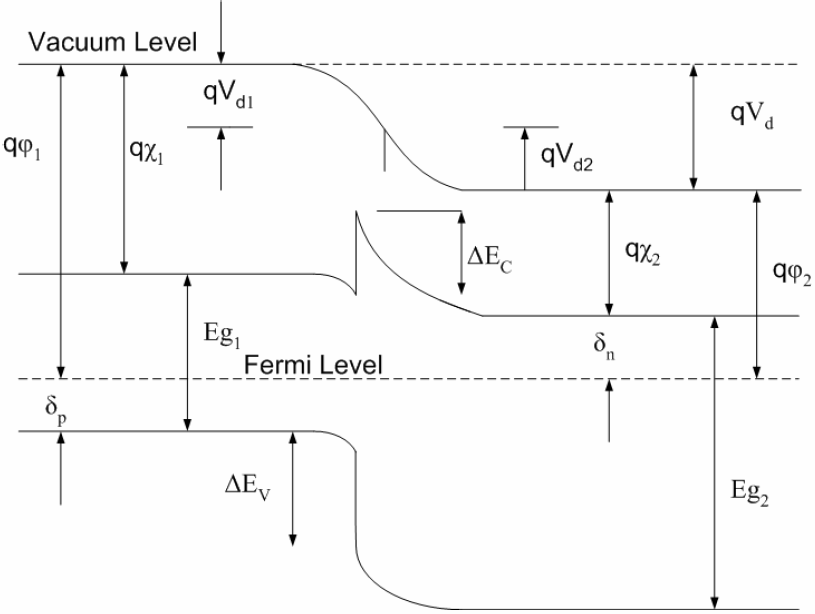
The electronic structures of the two materials differ, leading to the formation of an electric field around the boundary, or junction, between them. Heterojunctions are of two types, isotype and anisotype heterojunctions. Isotype heterojunctions are the one formed with materials of same conductivity and anisotype are formed with materials of different conductivities. The band bending of heterojunctions is not as smooth as the homojunctions because of difference in electron affinities, work functions, etc. These cause interface states or band discontinuities which form the recombination centers.

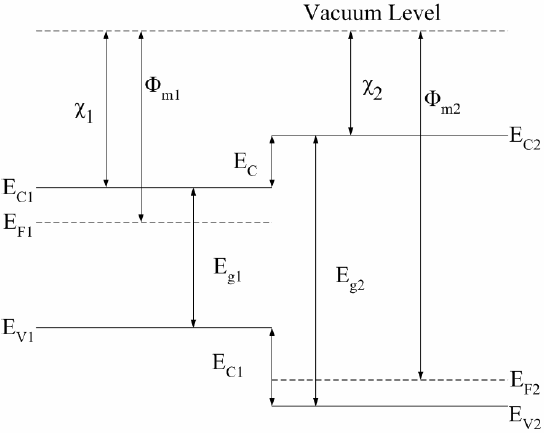
The energy band diagram of two semiconductor materials prior to forming a junction is shown below:

The two semiconductors have different bandgaps Eg1 and Eg2, different work functions Fm1 and Fm2, different electron affinities x1 and x2 and different permittivities e1 and e2. The energy band diagram of a heterojunction is shown below:

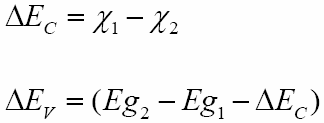
The band discontinuities are given by


Contact us: Feedback


Other readings:
Optical Absorption of Light in Semiconductors
N-Type Semiconductor
Mid-gap energy levels due to atomic impurities
Ideal Diode and Diode Equation
Diodes
Depletion Region of P-N Junction
Specimen Interaction Volume during Microanalysis
Electron Material (Specimen) Interaction in Microanalysis
Operating Parameters of Four Types of Electron Sources
Limiting factors of EDS (Energy Dispersive X-ray Spectroscopy)
Energy Dispersive X-ray Detector


Copyright (C) 2006 GlobalSino, All Rights Reserved