Chapter/Index: Introduction | A | B | C | D | E | F | G | H | I | J | K | L | M | N | O | P | Q | R | S | T | U | V | W | X | Y | Z | Appendix
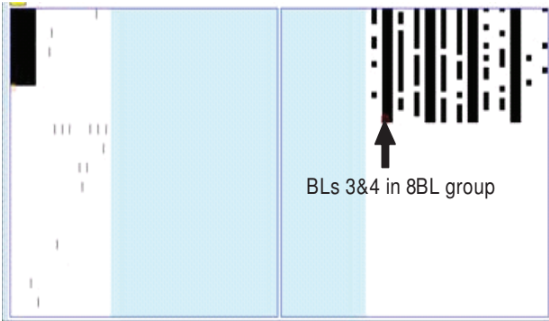
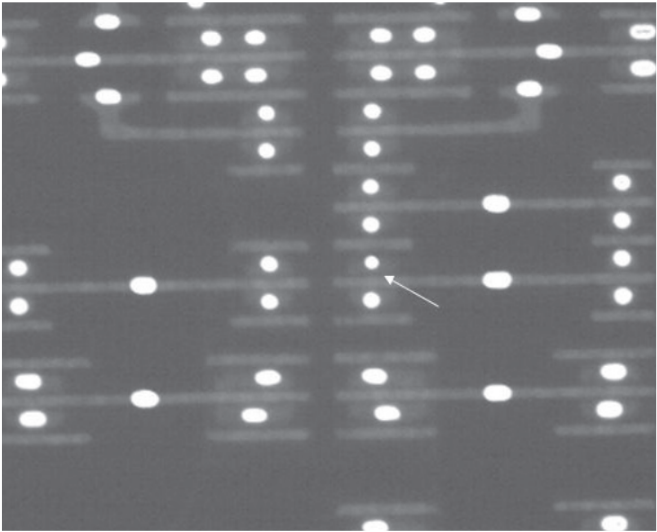
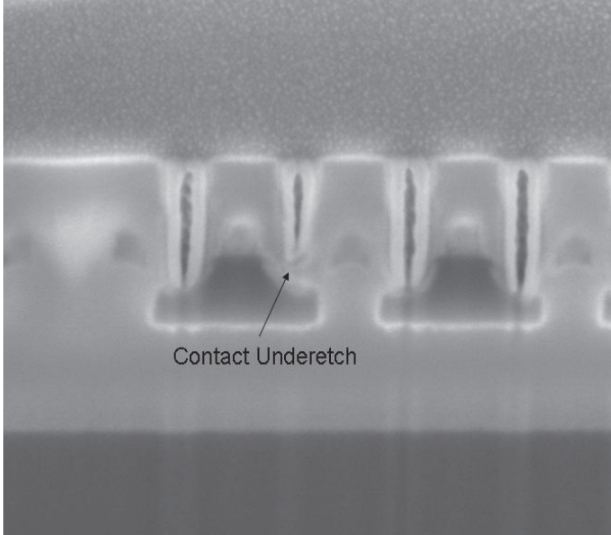
| Bitlines (BL) Type Failure in SRAM refers to a specific type of fault where bitlines (BLs) in the memory array consistently fail in a patterned way. This failure is characterized by issues along particular bitlines, often presenting as repeated faults in certain bitline groups or sections, rather than isolated faults within individual memory cells. In BL Type Failures, the cause is typically not located within the affected bitline itself. Instead, it may be related to defects in the bitline decoder or related interconnects, which control the entire group of bitlines. Possible issues could include short circuits with adjacent lines (like Vdd or Vss), open connections, or other structural problems within the bitline decoder circuitry. As a result, BL Type Failures often require more complex analysis techniques, such as layout tracing and physical failure analysis, to locate and address the underlying defect. For instance, one troubleshooting procedure for such BL Type Failure in SRAM involves:
This methodology above highlights systematic pattern analysis, followed by targeted tracing and physical examination, to isolate and confirm the cause of BL type failures.
[1] Z. Song, SRAM failure analysis evolution driven by technology scaling, Proceedings of the 21th International Symposium on the Physical and Failure Analysis of Integrated Circuits (IPFA), DOI: 10.1109/IPFA.2014.6898207, 2014.
|