Chapter/Index: Introduction | A |
B |
C |
D |
E |
F |
G |
H |
I |
J |
K |
L |
M |
N |
O |
P |
Q |
R |
S |
T |
U |
V |
W |
X |
Y |
Z |
Appendix
Overshoot Voltage (Voltage Spikes) due to High di/dt in MOSFETs
| High di/dt during fast switching transients can cause semiconductor device failure due to overshoot voltage:
- di/dt represents the rate of change of current over time. When a device like an SiC MOSFET switches at very high speeds, the current can change very rapidly, leading to a high di/dt.
- Fast Switching Transients occur when MOSFETs turn on or off quickly. In the case of SiC MOSFETs, which are designed for high-frequency operation, the switching transients are much faster than those of traditional silicon devices. This rapid switching can cause sharp changes in current (high di/dt).
- Overshoot Voltage (also known as voltage spikes) can occur during these fast switching events due to the inductance present in the circuit. Even small parasitic inductances in the circuit layout (such as those in the wires, traces, or package) can cause significant voltage overshoot when switching at high di/dt.
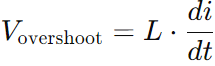
The overshoot voltage is directly proportional to the stray inductance in the current commutation loop and is a result of the energy stored in the magnetic field along the current path. [2] The voltage overshoot is given by the formula:
 ------------------------------------------------------------ [1311a] ------------------------------------------------------------ [1311a]
where,
L is the inductance.
di/dt is the rate of current change.
Semiconductor Device Failure can happen when the voltage overshoot exceeds the device’s maximum voltage rating. Even though SiC MOSFETs are more robust than silicon MOSFETs, repeated high voltage overshoots or spikes can eventually lead to the degradation of the device or immediate failure due to exceeding the breakdown voltage of the semiconductor.
SiC MOSFETs can switch up to 10 times faster than their silicon counterparts due to their lower junction capacitance and reduced specific on-resistance. [1] These faster switching transitions result in di/dt rates that are 5 to 10 times higher for SiC MOSFETs compared to IGBTs.
[1] Yi, P., Murthy, P. K. S., & Wei, L. “Performance evaluation of SiC
MOSFETs with long power cable and induction motor”. Energy
Conversion Congress and Exposition (ECCE), 2016.
[2] Lamp, J. "IGBT peak voltage measurement and snubber capacitor
specification." Application Note AN-7006, SEMIKRON (2008).
|
