Chapter/Index: Introduction | A | B | C | D | E | F | G | H | I | J | K | L | M | N | O | P | Q | R | S | T | U | V | W | X | Y | Z | Appendix
| Figure 2333a shows EBSD geometry together with camera length (L).
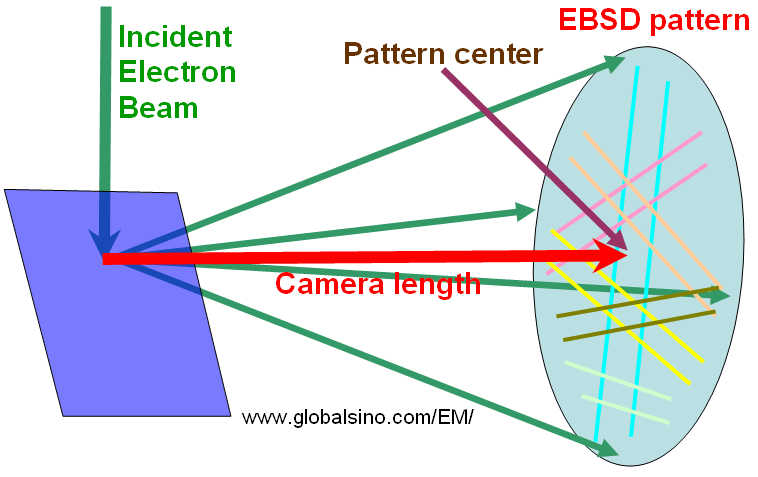
Figure 2333a. EBSD geometry together with camera length (L). The camera length influences the projected image of crystal planes on the detector. Longer camera lengths improve sensitivity to certain shear components (U13, U23) but reduce sensitivity to others (U31, U32), due to the inverse relationship between these components and the camera length. The projected image components on the detector plane can be given by, [1]
where,
In Equations 2333a and 2333b, the terms involving and are divided by , indicating that the sensitivity to these components decreases with increasing camera length. Conversely, the terms involving U13 and U23 are multiplied by , showing that the sensitivity to these components increases with longer camera lengths. Figure 2333b compares the original grid with the deformed grid based on Equations 2333a and 2333b. Figures 2333b (a) and (c) show the original positions, while Figures 2333b (b) and (d) illustrate how the grid is deformed by applying the two equations, with deformation components that are dependent on the camera length . The blue arrows in the right panel show the direction and magnitude of the deformations according to the equations.
The relationship between camera length and the sensitivity to different strain components, in Equations 2333a and 2333b of the EBSD measurements, creates a balance where an optimal camera length exists for strain measurements, balancing signal strength and blurring effects. Errors in pattern center calibration, including camera length, can lead to "phantom strains," which can affect the accuracy of stress state measurements in the crystal. In addition to the effects of camera length on strain sensitivity, some other impacts of camera length on EBSD measurements are:
[1] Jon Alkorta, Limits of simulation based high resolution EBSD, Ultramicroscopy 131 (2013) 33–38.
|