=================================================================================
In electron-optical systems, (as well as light-optical systems), lens can work as an aperture because it can constraint the incident wave front. This is more easily understood for light-optical systems because the aperture effect is due to the finite surface area of the optical lens;
Assuming the incident wave has a complex wave function just before the lens, given by,
 --------------------------- [4159a] --------------------------- [4159a]
After the incident wave crosses the lens, the wave function becomes,
 --------------------------- [4159b] --------------------------- [4159b]
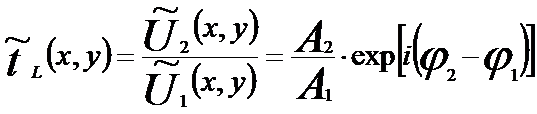
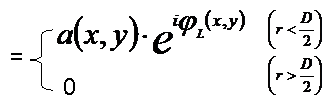
So that the aperture function of the lens is given by,
 ------------------- [4159c] ------------------- [4159c]
 ------------------ [4159d] ------------------ [4159d]
where,
D -- The diameter of the lens
r -- The distance from the incident point to the optic axis of the lens (r = (x2+y2)1/2)
The lens behavior constraining the wave plane to r < D/2 is so-called aperture function of the lens. For electron-optical system, the absorption of the lens is zero so that a(x,y) = A2/A1 ≈ 1. Therefore, the lens function becomes pure phase function.
|