|
This book (Practical Electron Microscopy and Database) is a reference for TEM and SEM students, operators, engineers, technicians, managers, and researchers.
|
=================================================================================
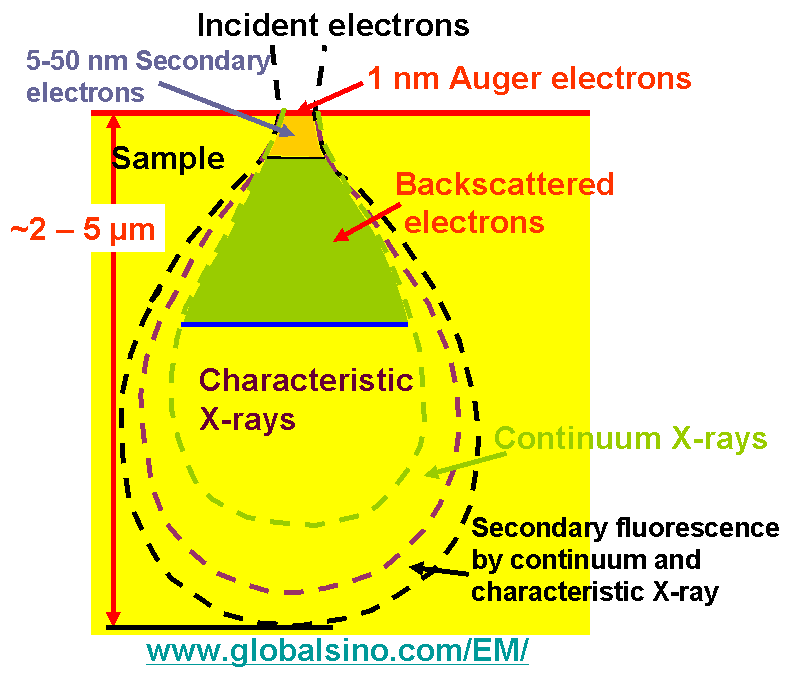 |
| Figure 4601. The interaction volumes for generations of secondary electrons, Auger electrons, backscattered electrons, characteristic X-rays, continuum X-rays, and secondary fluorescence (X-rays). |
The volume, inside the specimen in which interactions occur while being struck with accelerating electrons, is called interaction volume. This volume depends on several factors such as atomic number of the materials of the specimen, accelerating voltage of the electron beam, and angle of the incident electron beam, because the materials with higher atomic number absorb or stop more electrons (having a smaller interaction volume), higher voltages penetrate farther into the sample and generate larger interaction volumes, and the greater the angle (further from normal) the smaller the volume. For comparison, Figure 4601 shows the interaction volumes for generations of secondary electrons (SEs), Auger electrons, backscattered electrons, characteristic X-rays, continuum X-rays, and secondary fluorescence (X-rays).
Note that the interaction volume for generation of SEs reflects the emission depth of SEs. Table 4601 lists some examples of emission depths of SEs depending on the accelerating voltages.
Table 4601. Some examples of emission depths of SEs depending on the accelerating voltages.
| |
Accelerating voltage of incident electron beam |
15 kV |
20 kV |
Cu (copper) |
|
5 ~ 50 nm |
SiO2 |
~1 µm |
|
|