|
This book (Practical Electron Microscopy and Database) is a reference for TEM and SEM students, operators, engineers, technicians, managers, and researchers.
|
=================================================================================
Materials such as CeF3 and Ce3+-doped yttrium-aluminum garnet (Y3Al5O12 garnet (YAG)), and various doped plastics and glasses are utilized for scintillating
and/or white light generating applications because of their
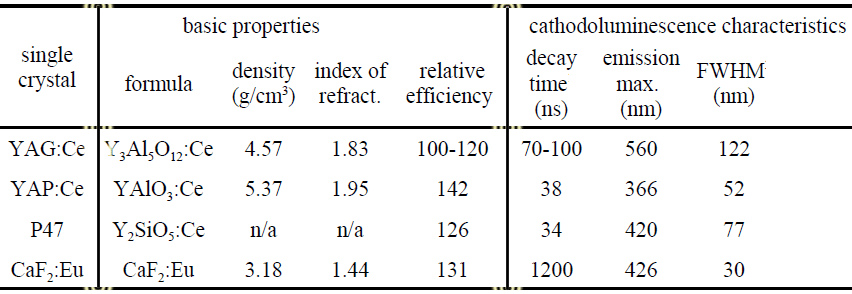
characteristic emission properties [2-6], rather than ZnS materials. The decay time of YAG and ZnS materials are on the orders of nanoseconds and microseconds, respectively. Some properties of single crystal scintillators are listed in Table 4908 [1]. The most often used is YAG:Ce single crystal, which is not the most optimal scintillator but is relatively cheap.
Table 4908. Properties
of some single crystal scintillators.
YAG material is an electrical insulator and tends to accumulate internal charge
in intensively electron-irradiated regions, locally and temporarily enhancing
its conversion efficiency. It has been found possible to reduce this artifact by
‘annealing’ theYAG scintillator by prolonged illumination with a broad (undispersed) electron
beam. Similar to Ce2Zr2O7-8, the properties of the oxides such as CeF3 and Ce3+-doped oxides (Y3Al5O12 garnet (YAG)) are closely related to the configurations of Ce4f-based states.
[1] P. Schauer and R. Autrata, Optimization of scintillation detector for SEM, EMC 2004 - Proceedings of the 13th European Microscopy Congress.
[2] 1) E. Auffray et al.: Nucl. Instrum. Methods Phys. Res. A 383 (1996) 367 -
390.
[3] C. Dujardin, C. Pedrini, N. Garnier, A. N. Belsky, K. Lebbou, J. M. Ko
and T. Fukuda: Opt. Mater. 16 (2001) 69–76.
[4] R. L. Nigro, G. Malandrino, I. L. Fragala, M. Bettinelli and A.
Speghini: J. Mater. Chem. 12 (2002) 2816–2819.
[5] Y. Dong, G. Zhou, J. Xu, G. Zhao, F. Su, L. Su, G. Zhang, D. Zhang,
H. Li and J. Si: Mater. Res. Bull. 41 (2006) 1959–1963.
[6] M. Kottaisamy, P. Thiyagarajan, J. Mishra and M. S. Ramachandra
Rao: Mater. Res. Bull. 43 (2008) 1657–1663.
|