=================================================================================
In TEM imaging mode, if no
objective aperture is used then the collection angle is very large
(> ~ 100 mrads) and need not be calculated accurately for EELS analysis
because small differences in a large β do
not affect the EELS spectrum or subsequent quantification.
To calculate β in
image mode with no aperture inserted, one needs to
know the magnification of the diffraction pattern (DP) in the back-focal
plane of the projector lens (which is the front-focal
plane of the spectrometer), given by
β = r0/L ------------------------------------------ [4933a]
here, r0 is the maximum radius of the DP in the focal
plane of the spectrometer (e.g. typical value of ~ 5 µm), and L is camera length defined by Magnification versus Camera Length. The typical value of β is ~ 100 mrad.
When an objective aperture is inserted, the collection angle can be easily calculated by considering the
geometrical size and focal length of the objective lens (as shown in Figure 4933) and using Equation [4929], given by,
β = R0/f ------------------------------------------ [4933b]
here, R0 is the radius of objective aperture and f the focal length of the objective lens.
The reason why we do not need to consider the entrance aperture of EELS/GIF setup is that all the electrons through the objective aperture to the spectrum setup fall into the entrance aperture. However, some considerable
error due to chromatic aberration can occur.
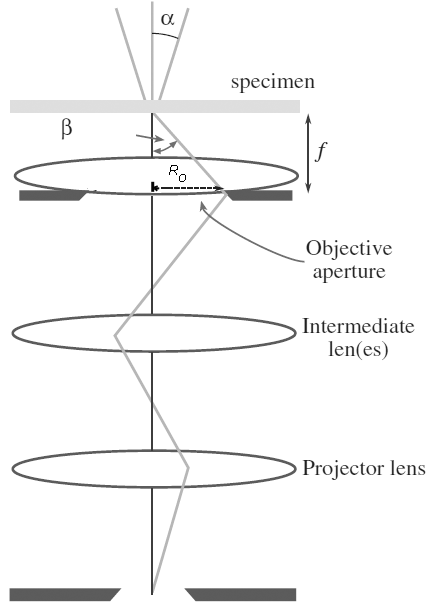
Figure 4933. Schematic diagram showing β in TEM image mode is determined by the
dimensions of the objective aperture.
|