Practical Electron Microscopy and Database

An Online Book, Second Edition by Dr. Yougui Liao (2006)

Practical Electron Microscopy and Database - An Online Book

Chapter/Index: Introduction | A | B | C | D | E | F | G | H | I | J | K | L | M | N | O | P | Q | R | S | T | U | V | W | X | Y | Z | Appendix

Interaction Volume of Incident Electrons

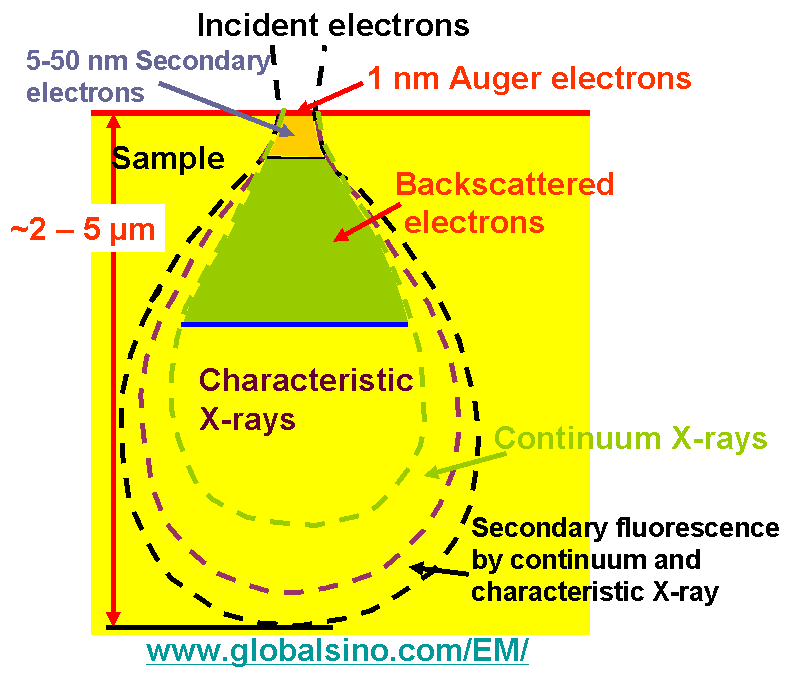
The volume inside the specimen in which interactions occur while being struck with accelerating electrons. This volume depends on several factors such as atomic number of the materials of the specimen, accelerating voltage of the electron beam, and angle of the incident electron beam, because the materials with higher atomic number absorb or stop more electrons (having a smaller interaction volume), higher voltages penetrate farther into the sample and generate larger interaction volumes, and the greater the angle (further from normal) the smaller the volume. For comparison, Figure 4967a shows the interaction volumes for generations of secondary electrons, Auger electrons, backscattered electrons, characteristic X-rays, continuum X-rays, and secondary fluorescence (X-rays).

The interaction volumes for generations of secondary electrons, Auger electrons, backscattered electrons, characteristic X-rays, continuum X-rays, and secondary fluorescence (X-rays).

Figure 4967a. The interaction volumes for generations of secondary electrons, Auger electrons, backscattered electrons, characteristic X-rays, continuum X-rays, and secondary fluorescence (X-rays).  

The models and experimental data are well-established regarding the interaction depth of incident electrons in SEM (scanning electron microscopy), which is influenced by factors like beam voltage (accelerating voltage) and material properties such as atomic number and density. Kanaya-Okayama Range Equation below is commonly used for providing an empirical model to estimate the maximum penetration depth R of electrons into a material, given by,


Kanaya-Okayama Range Equation -------------------------------------------------------------------- [4967a]

where,

  • = incident beam energy (in keV).
  • = material density (g/cm³).
  • = atomic number of the material.

For instance, for silicon (Si), where Z = 14, and ρ = 2.33 g/cm³, the interaction volume dimensions can vary from ~10 nm for 0.5 keV to several microns for 30 keV. The penetration depth is ~500 nm at 5 keV, and ~2–3 µm at at 20 keV. For gold (Au), where Z = 79 and ρ = 19.32 g/cm³, the penetration depth is ~50 nm at 5 keV, and ~200–300 nm at 20 keV. Figure 4967b shows the penetration depth versus beam voltage for various materials.

Penetration depth versus beam voltage for various materials

Figure 4967b. Penetration depth versus beam voltage for various materials.