Chapter/Index: Introduction | A | B | C | D | E | F | G | H | I | J | K | L | M | N | O | P | Q | R | S | T | U | V | W | X | Y | Z | Appendix
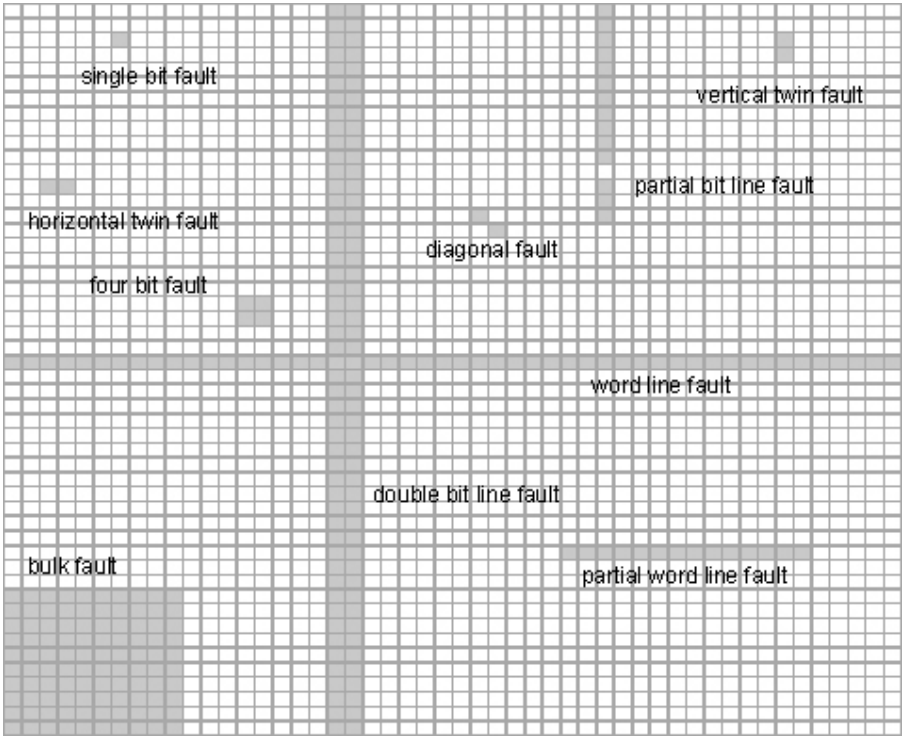
| Bitmap data is a collection of data representing the failing bits in the repeated memory structures of an integrated circuit, such as SRAM. During wafer sorting, this data is gathered to pinpoint specific locations of failing bits within memory blocks, often arising due to process issues or specific defect patterns. Bitmap data can reveal failure modes such as edge, center, and localized yield losses across a wafer, helping to identify recurring process-related failures. Analyzing bitmap data enables targeted yield improvement by recognizing patterns linked to particular process failures. This figure illustrates typical bitmap failure patterns recognized in SRAM, showing how different types of failures (e.g., bulk failures, word line failures, bit line failures) can manifest. The image depicts how specific patterns of failing bits within memory structures are associated with particular failure mechanisms, which is essential for understanding process-induced defects in semiconductor manufacturing.
Bitmap data and Wafer Bin Map (WBM) data are related but serve distinct purposes in semiconductor manufacturing:
While bitmap data may focus on internal memory cells and failure specifics, WBM data presents a macro-level view of wafer performance. Both can be used together for comprehensive yield analysis, where WBM identifies broader trends, and bitmap data provides finer details of failure within individual dies.
[1] Hsieh, Y.-L., Tzeng, G.-H., Lin, T. R., & Yu, H.-C., Wafer Sort Bitmap Data Analysis Using the PCA-Based Approach for Yield Analysis and Optimization. IEEE Transactions on Semiconductor Manufacturing, 23(4), 493–503. https://doi.org/10.1109/TSM.2010.2065510, 2010.
|