=================================================================================
The nearly free electrons in the metallic tin (Sn) comprising the conduction bands give rise to the plasmon excitations of Ebulk = √2Esurface. Therefore, the predominant peaks originated from surface- and bulk-plasmon losses are at 10 and 14 eV respectively.
Figure 2300 shows REELS profiles taken from a polycrystalline Sn surface using a 200-eV primary beam, an incidence angle of 45°, and different collection angles β. The spectrum taken at the collection angle of 80° is the most surface sensitive of the three with the strongest peak of the surface-plasmon loss at 10 eV, and the one taken at 0° is the most bulk sensitive with the strongest peak of the bulk-plasmon loss at 14 eV. The dependence of the REELS signal on the collection angle is discussed in page2301.
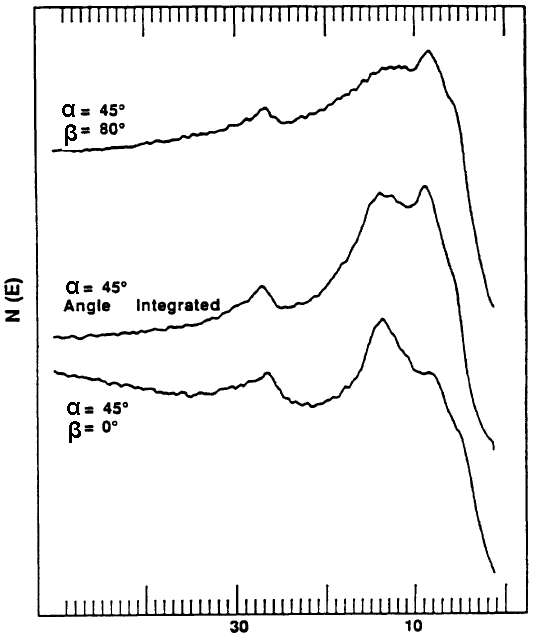
Figure 2300. REELS profiles taken from a polycrystalline Sn surface using a 200-eV primary beam, an incidence angle of 45°, and different collection angles β. Adapted from [1]
[1] Gar B.Hoflund and Gregory R. Corallo, Electron-energy-loss study of the oxidation of polycrystalline tin, Phys. Rev. B 46, 7110–7120 (1992). |