Chapter/Index: Introduction | A | B | C | D | E | F | G | H | I | J | K | L | M | N | O | P | Q | R | S | T | U | V | W | X | Y | Z | Appendix
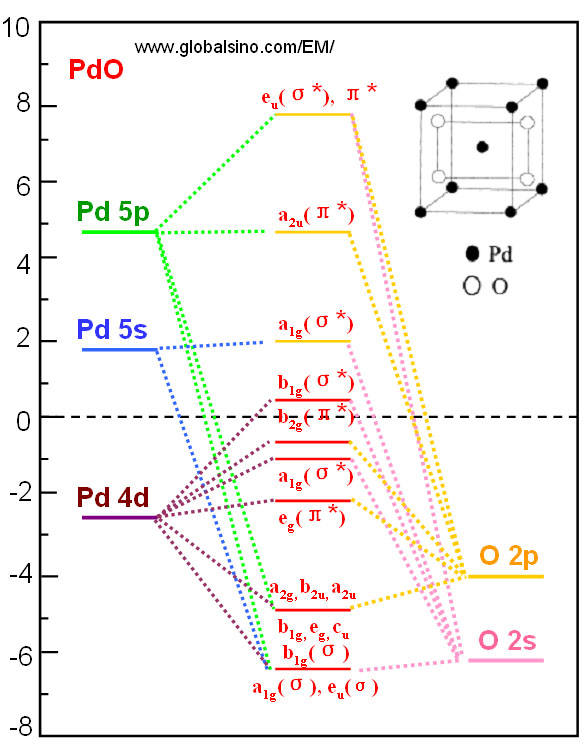
| The crystal structure of PdO is body-centered tetragonal, where each O ion is tetrahdrally coordinated to four Pd ions and each Pd ion is coordinated to four O ions in a square-planar orientation. The molecular orbital energy level is shown schematically in Figure 2304. Basic understanding on the possibility of the allowed interband transitions may be obtained by considering the crystalline structure of PdO and the corresponding orbital symmetry, hybridization and approximate energy levels. For instance, the transitions from the bonding O 2p–Pd 4d to the anti-bonding O 2p–Pd 5s and O 2p–Pd 5p hybrid orbitals with ag (5s) and au (5p) symmetry would induce energy losses of 6.8 and 9.6 eV, respectively [1]. Interband transitions from the bonding O 2s–Pd 4d to the anti-bonding O 2s–Pd 4d and O 2s–Pd 5s orbitals would induce energy losses around 6.4 and 8.4 eV. These superimposed losses may yield the broad structure centered at 7.6 eV.
Figure 2304. Schematic illustration of molecular orbital energy level for Pd
[1] Helena A.E. Hagelin, Jason F. Weaver, Gar B. Hoflund, Ghaleb N. Salaita, Electron energy loss spectroscopic investigation of palladium metal and palladium(II) oxide, Journal of Electron Spectroscopy and Related Phenomena 124 (2002) 1–14.
|