Practical Electron Microscopy and Database

An Online Book, Second Edition by Dr. Yougui Liao (2006)

Practical Electron Microscopy and Database - An Online Book

Chapter/Index: Introduction | A | B | C | D | E | F | G | H | I | J | K | L | M | N | O | P | Q | R | S | T | U | V | W | X | Y | Z | Appendix

Dead Layers in EDS Detector

In an Energy Dispersive X-ray Spectroscopy (EDS) detector, dead layers refer to regions within the detector that are unresponsive to incoming X-rays and therefore do not contribute to the detection signal. These layers are usually present on the surface of the detector or immediately behind it, and they can absorb some of the incident X-rays before they reach the active region where detection occurs. As a result, X-rays that interact with dead layers are effectively "lost," reducing the efficiency and sensitivity of the detector. 

Dead layers are typically made up of materials that help protect the detector, such as passivation layers or insulating layers, but they also act as a barrier, diminishing the detector's ability to pick up weaker X-rays, especially from lighter elements. Key points about dead layers in EDS detectors include:

  • Reduced Sensitivity for Low-Energy X-rays: Dead layers can cause a decrease in sensitivity to low-energy X-rays, as these X-rays are more easily absorbed before reaching the active detection area.
  • Impact on Detection Efficiency: They reduce the overall detection efficiency of the EDS system, particularly for elements that emit lower-energy X-rays, resulting in weaker signals or even undetectable peaks for certain elements.
  • Effective Path Length: The effective thickness of dead layers varies depending on the detector design and material composition, with thinner dead layers generally preferred in detectors intended for higher sensitivity to light elements.
  • Minimizing Dead Layer Thickness: Advances in EDS detector technology aim to reduce the thickness of dead layers to improve performance, especially for applications requiring high sensitivity to lighter elements like boron or carbon.

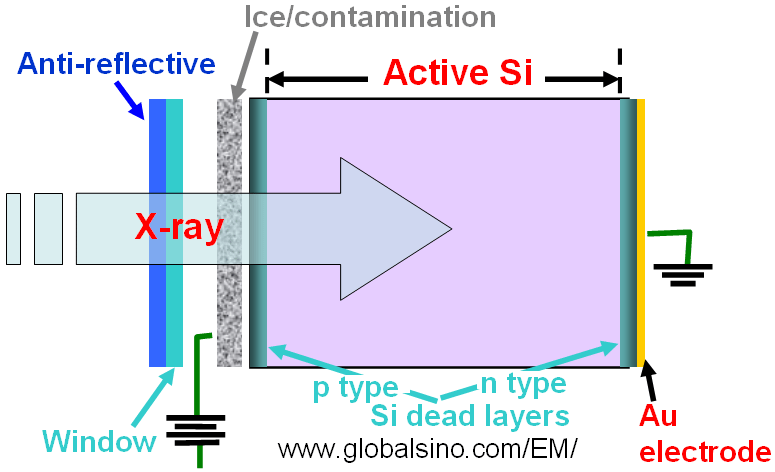
Figure 3806a shows the structure of EDS detector. The active Si can be an intrinsic silicon crystal in thickness of about 3 mm. The collector of e-h pairs is a reversed p-i-n structure. The Si dead layers are p-/n-type silicon crystal in thickness of about 100 nm. The existing dead layers also indicate that the generated charges cannot be completely detected.

Structure of EDS detector

Figure 3806a. Structure of EDS detector.

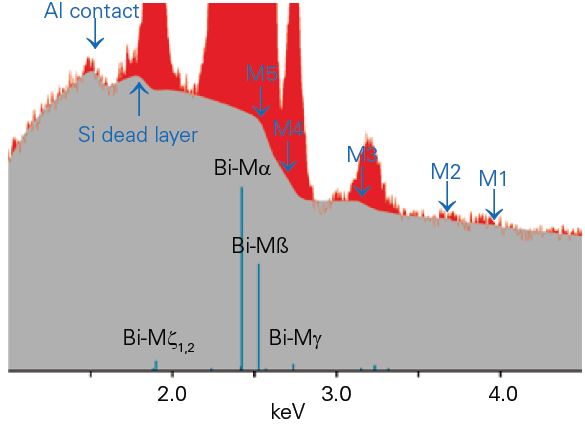
Figure 3806b shows the EDX spectrum of bismuth (Bi). The bremsstrahlung background in grey was obtained by physical modeling. In the spectrum, the absorption edges of the X-ray lines of the elements (Al contact, Si dead layer) on the detector surface are also visible.

EDX spectrum of bismuth (Bi)

Figure 3806b. EDX spectrum of bismuth (Bi). [1]


[1] QUANTAX, EDS Analysis for SEM and TEM, Bruker.