Chapter/Index: Introduction | A | B | C | D | E | F | G | H | I | J | K | L | M | N | O | P | Q | R | S | T | U | V | W | X | Y | Z | Appendix
| In general, a low voltage STEM is a hybrid instrument with the features of SEM and TEM with a convergent probe, while a high voltage TEM is a hybrid instrument with the features of TEM with both a parallel beam (for TEM function) and a convergent probe (for STEM function).
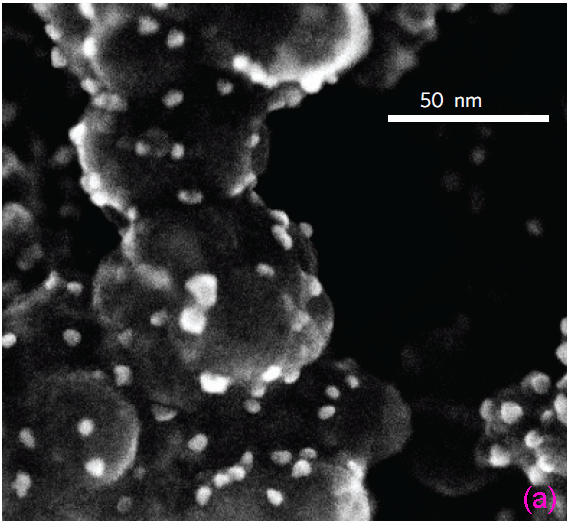
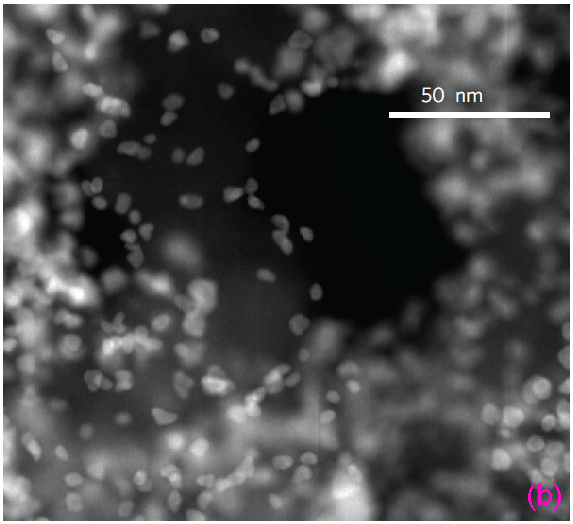
Figure 4447a shows the contrast difference of Pd (Palladium) particles on a thin carbon film. The image (a) using SEs as well as BSEs clearly gives rich depth information, or three-dimensional (3-D) information, about the locations of the particles, while the STEM image cannot give such information.
Figure 4447a. (a) SEM image of Pd nanoparticles on a carbon support obtained using SEs and BSEs; (b) STEM image obained using transmitted electrons (TEs) with an ADF detector.
Adapted from [1].
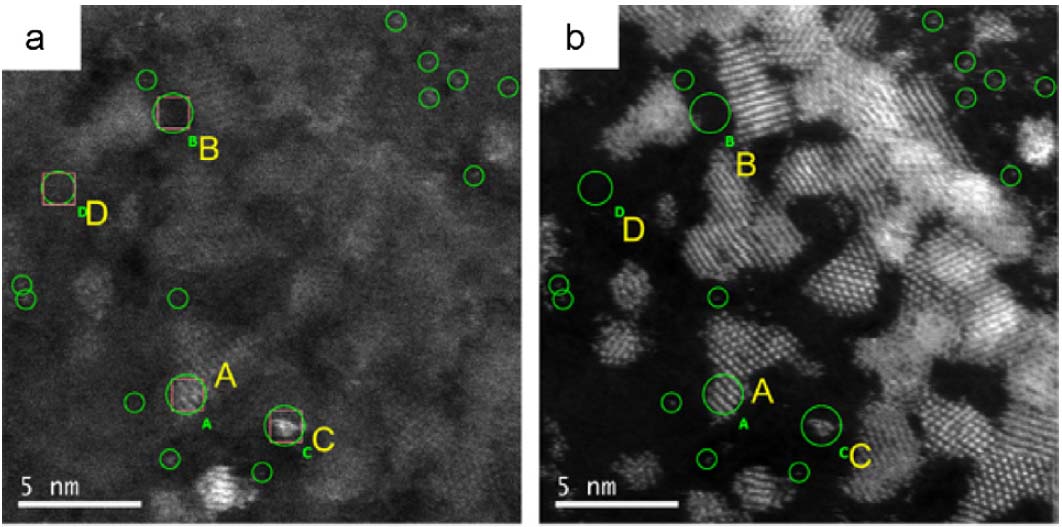
Figure 4447b shows an example of SEM/STEM images taken from uranium oxide particles on carbon film at atomic resolution in both SEM mode and ADF-STEM mode in Cs-corrected Hitachi HD 2700C. It is clear that the contrast of STEM is much better than that of SEM.
Figure 4447b. SEM/STEM images taken from uranium oxide particles on carbon film at atomic resolution in SEM mode (a) and ADF-STEM mode(b). [2] Furthermore, the comparison between the EDS measurements in low-energy SEM and high-energy (S)TEM is listed on a table on page4532.
[1] Y. Zhu, H. Inada, K. Nakamura, and J. Wall, Imaging single atoms using secondary electrons with an aberration-corrected electron microscope, Nature Materials, 8 (2009) 808.
|