Chapter/Index: Introduction | A | B | C | D | E | F | G | H | I | J | K | L | M | N | O | P | Q | R | S | T | U | V | W | X | Y | Z | Appendix
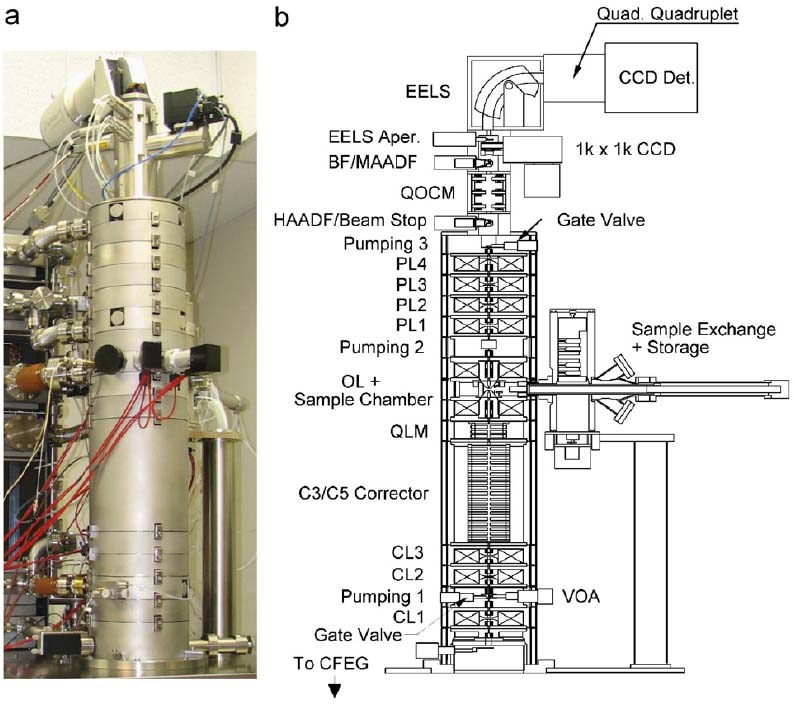
| Spherical Aberration (Cs) correction was first introduced by Rose [1,2] However, due to the need for high mechanical precision and lens current stability, as well as for computer control, Cs correctors had not been achieved until the end of the 20th century [3, 4]. The first practical aberration corrector was installed on a test bench to verify the applicability of Cs correction [12]. The demonstration setup on a modified SEM included a Cs corrector entirely incorporated into a specimen chamber and a CCD camera coupled with a scintillator underneath the specimen chamber. The electron probe was focused on the scintillator, and scanned circularly with a series of diameters so that the ray displacements induced by the aberration corrector could be observed. In scanning TEM, the resolution-limiting factor is the size of the focused electron probe. As shown in Equation [4954d], the beam size can be reduced by minimizing Cs. With use of Cs correctors, it was demonstrated that probe size below 0.1 nm can be achieved [5 - 8]. An important advantage of Cs correctors is that larger acceptance angles can be used that increase the probe current considerably. In the TEM, Cs correctors allow for a much more straightforward interpretation of high-resolution images. Furthermore, a negative Cs value of objective lens has been applied in materials studies. For instance, this technique simplified the detection of light atoms [9] and enabled to image all types of atomic columns in the dielectric SrTiO3 and the superconductor YBa2Cu3O7 [10]. Spherical aberration correctors combine multipoles and rotational symmetry lenses. The example in Figure 4945 shows a TEM system facilitated with a C3/C5 corrector for spherical aberration corrections. Note that different from most commercial TEM systems (see schematic diagram of TEM systems), this TEM system without phosphor screen has the incident electrons emitted from the bottom of the systems and the detectors on the top.
[1] Rose H. 1990. Outline of a spherically
corrected semiaplanatic medium-voltage
transmission electron-microscope.
Optik 85:19–24
|
||||