Chapter/Index: Introduction | A | B | C | D | E | F | G | H | I | J | K | L | M | N | O | P | Q | R | S | T | U | V | W | X | Y | Z | Appendix
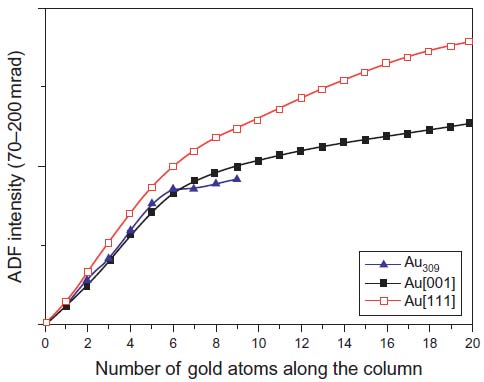
| Wedge-shaped TEM specimens can be used to verify the validity of theoretical modeling, for instance, performed for contrast analysis of HAADF STEM images. In Figure 2574, multislice simulation presents the total cross section of Au (gold) as a function of the number of atoms in a Au column.[1] In other words, the HAADF intensity depends on the atomic number (Z-contrast) as well as the number of atoms in the column. Without the need for a calibration standard, LeBeau et al. [2] were able to quantify the number and location of the atoms in the specimen from 4 to 33 atom column height when the experimental images taken from a wedge-shaped Au thin foil was compared directly with theory.
Figure 2574. HAADF intensity as a function of the number of atoms along the Au column, obtained by multislice simulation. [1]
|