
Chapter/Index: Introduction | A | B | C | D | E | F | G | H | I | J | K | L | M | N | O | P | Q | R | S | T | U | V | W | X | Y | Z | Appendix
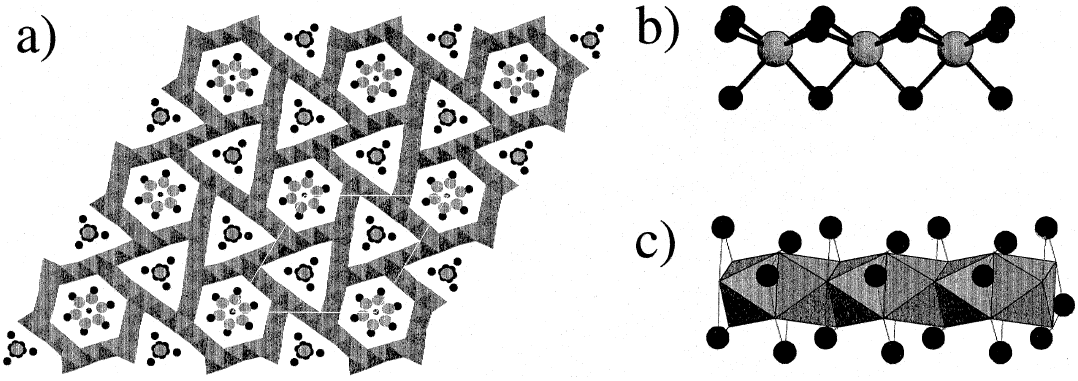
| The general formula A1-pCr2X4-p (A = Ba, Sr, Eu, Pb, X = S, Se) [1 - 3] represents an unusual average structure formed by the intergrowth of three different substructures that are mutually incommensurate along one direction. The structure [4] shown in Figure 3474a is formed by a three-dimensional (3-D) Cr7S12 framework raising the strips of edge-sharing octahedra {CrX6} as a triple twinning {111} of NaCl-type and thus, resulting in a hexagonal symmetry sublattice. This 3-D framework forms two different types of tunnels with hexagonal and trigonal geometry. The columns with composition A3CrX3 located in the hexagonal tunnels and the columns with composition A3X located in the trigonal tunnels. There are one hexagonal tunnel and two trigonal tunnels in an unit cell. Both types of columns present hexagonal lattices with the same lattice parameters.
Figure 3474b shows the SAED (selected-area electron diffraction) patterns of A1-pCr2X4-p crystals along the [0001] zone axis, revealing only the Bragg reflections hk0, which are common to the three sublattices.
Figure 3474b. SAED pattern of PbCr2S4 crystals oriented along the [0001] zone axis. [5]
Surprisingly, the high-resolution images along [0001] (given in Figure 3474c) does not correspond to the expected six-fold symmetry as indicated in Figure 3474b, but to three-fold symmetry.
Figure 3474c. HRTEM image of a crystal of a PbCr2S4 crystal imaged along the [0001] zone axis. The unit cell is outlined.
Figure 3474d shows the electron diffraction pattern along any [hki0] zone axis. The reflection spots originate from the 3-D framework Cr21S36, while the diffuse diffraction lines originate from the two columnar substructures Pb6Cr2S6 and Pb3S. The lack of correlation between columns of the same type results in planes of diffuse intensity instead of well-defined reflections, even though some degree of correlation between the columns still exist since the diffuse intensity of the planes are not uniform in the figure.
Figure 3474d. Electron diffraction pattern of a PbCr2S4 crystal oriented along the [2 -1 -1 0] zone axis.
[5]
[1] Brouwer, R., and Jellinek, F., 1977. Multiple order in sulfides and selenides.
Journal de Physique C7 38, 36 - 41.
|
![SAED pattern of PbCr2S4 crystals oriented along the [0001] zone axis](image1/3477b.jpg)
![HRTEM image of a crystal of a PbCr2S4 crystal imaged along the [0001] zone axis](image1/3477d.jpg)
![Electron diffraction pattern of a PbCr2S4 crystal oriented along the [2 -1 -1 0] zone axis](image1/3477c.jpg)