
Chapter/Index: Introduction | A | B | C | D | E | F | G | H | I | J | K | L | M | N | O | P | Q | R | S | T | U | V | W | X | Y | Z | Appendix
| The magnification of electron microscopes is defined as the ratio of a specimen size and an image size recorded on a CCD camera or photo-film. As discussed in Bell-Shaped Field in EMs, by introducing dimensionless coordinates y = r/a and x = z/a = cot φ (where we have the variable φ varying from π (z = −∞) to π/2 (z = 0) and then to 0 (z = +∞).), by following the theory of trajectories of electron in electron lenses, and by assuming a ray passing through a point P0(y0, φ0) in front of the lens, a image point P1(y1, φ1) can be theoretically obtained, where,
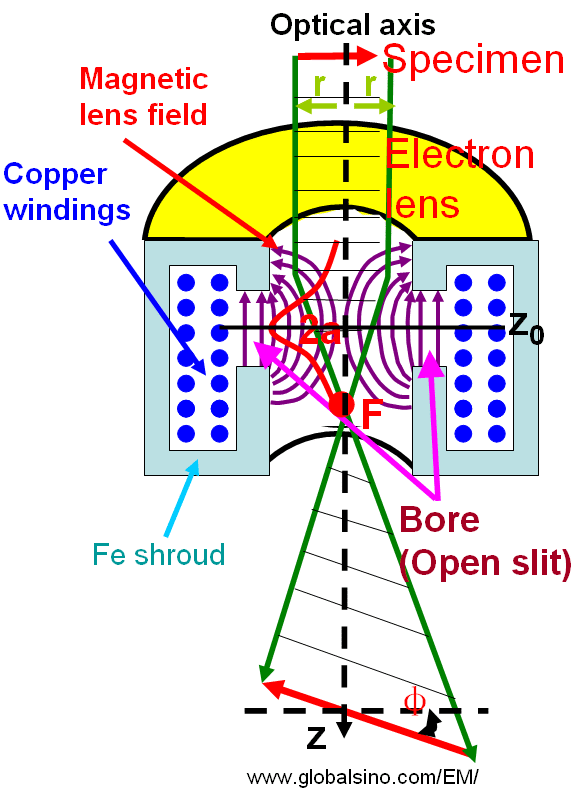
Figure 4274. Rotationally symmetric magnetic fields and electron lenses. Newton’s lens equation of light optics suggests Z0Z1 = f0f1. Further calculation based on bell-shaped field, we can obtain, We can see that the focal lengths f0 and f1 are not the same as the distances z(F0) and z(F1) of the foci from the lens center at z = 0, indicating that electron lenses cannot be treated as thin lenses. The magnification M in Equation 4274a can be re-written in terms of f and Z, M = f0/Z0 = Z1/f1 ------------------- [4274e]
|
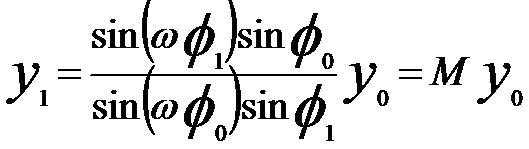 -------------------------- [4274a]
 ---------------------------------- [4274b]
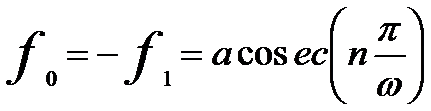 -------------------------- [4274c]
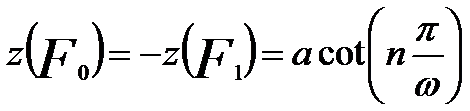 ------------------- [4274d]