Chapter/Index: Introduction | A | B | C | D | E | F | G | H | I | J | K | L | M | N | O | P | Q | R | S | T | U | V | W | X | Y | Z | Appendix
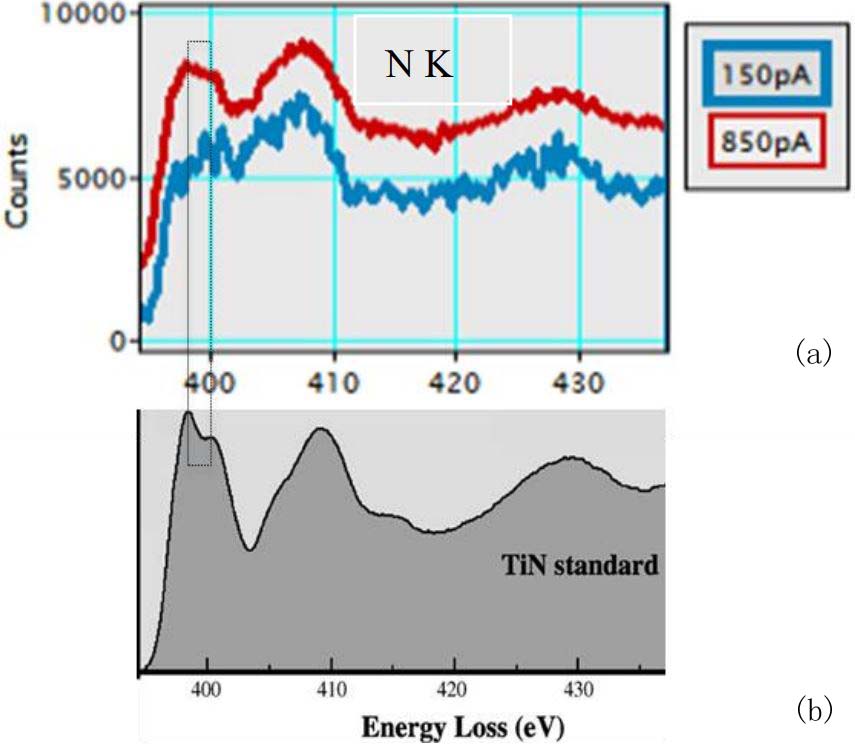
| It was proposed [1] that the EELS ionization cross sections are within 5% for most K-edges and 15% for most L-edges, and the accuracy for other edges is significantly uncertain. In some cases, the damage cross section (σd) is larger than the K-shel EELS ionization cross (σK) section, resulting in that the radiation damage prevents the detection of a single atom by K-shel EELS. If σd < σK, single atom detection is possible in principle. Figure 4403 shows the comparison of the extracted EELS spectra of the N K-edge at 401 eV from a same region with the electron beam current of 150 pA and 850 pA, respectively, and from a crystalline TiN standard sample. Table 4403 shows the comparison of π* pre-peaks of the three cases in Figure 4403. This split is caused by the excitation of an N 1s electron in unoccupied t2g and eg orbitals formed by the hybridization of N 2p and Ti 3d electrons. [2] The high electron beam flux of 850 pA used for the data acquisition changed the chemistry and morphology in the analyzed region.
Table 4403. π* pre-peak of the three cases in Figure 4403.
[1] Egerton, R. F. (1993) Oscillator-strength parameterization of inner-shell cross sections.
Ultramicroscopy 50, 13–28.
|