Chapter/Index: Introduction | A | B | C | D | E | F | G | H | I | J | K | L | M | N | O | P | Q | R | S | T | U | V | W | X | Y | Z | Appendix
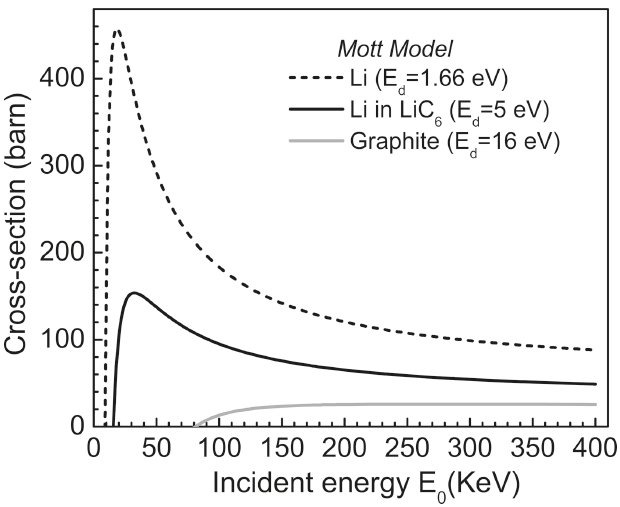
| During the collision process between incident electrons and a nucleus, if the energy (E) received by an atomic nucleus exceeds the atomic surface-binding energy Es, surface atoms can be removed in an average time, given by, The sputtering cross section can be given by, [1] Cross-sections (σ) of surface sputtering in conducting materials induced by electron irradiation is from 10-22 to 10-21 cm2. Conventional wisdom suggests that a low operating voltage (<100 kV) in TEMs is optimal for reducing radiation damage, but the calculated profiles as a function of incident electron energy E0 in Figure 4408 demonstrate the minimum displacement cross-sections for lithium atoms in the elemental Li, lithiated graphite (LiC6) and graphite are not at low operating voltages.
Figure 4408. The displacement cross-sections for lithium atoms in the elemental Li, lithiated graphite (LiC6) and graphite as a function of incident electron energy E0.
Ed is the displacement
energy. [2]
[1] Chadderton, L.T., 1965. Radiation Damage in Crystals, Methuen,
London.
|
 ------------------- [4408b]