Chapter/Index: Introduction | A | B | C | D | E | F | G | H | I | J | K | L | M | N | O | P | Q | R | S | T | U | V | W | X | Y | Z | Appendix
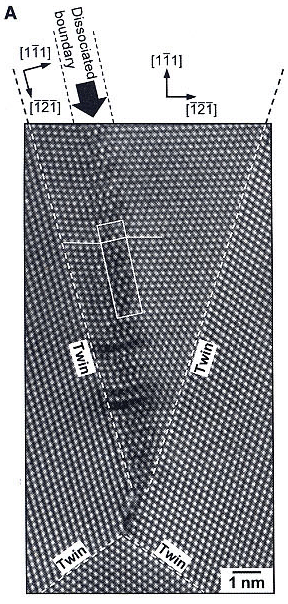
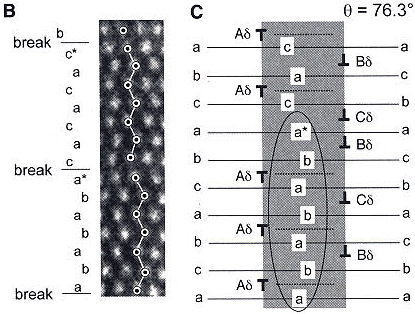
| Lucadamo and Medlin [1] used HRTEM technique to explain the geometric origin of hexagonal close packing (HCP) at a grain boundary of face centered cubic (FCC) gold (Au) grains. The HCP stacking formed at a <110> tilt boundary misorientation of 80.6°. The low stacking fault energy of Au, as indicated by Table 4732, enhances grain boundary dissociation and twin growth. Figure 4732 (A) shows a HRTEM image along a <110>-type zone axis, giving the intersection of five grain boundaries. Four of the boundaries are {111} twins and possess compact and well-defined cores. However, the fifth boundary presents a broad and dissociated core with a width of approximately 1 nm. The crystalline planes in the dissociated region bend upward as they cross into this region from the left and are deflected down on the right, as indicated by the solid line. From the closer study of the dissociated region as shown in Figure 4733 (B) and (C), they also proposed these close-packed planes within this region were arranged into HCP lattice (in "a-b-a" sequence) instead of FCC lattice (in "a-b-c" sequence).
Figure 4733. (A) HRTEM image showing five intersecting grain boundaries in FCC gold crystals; (B) Enlargement of the region
[1] Geometric origin of hexagonal close packing at a grain boundary in gold, G. Lucadamo and D. L. Medlin, Science, 23, 1272 (2003).
|