Chapter/Index: Introduction | A | B | C | D | E | F | G | H | I | J | K | L | M | N | O | P | Q | R | S | T | U | V | W | X | Y | Z | Appendix
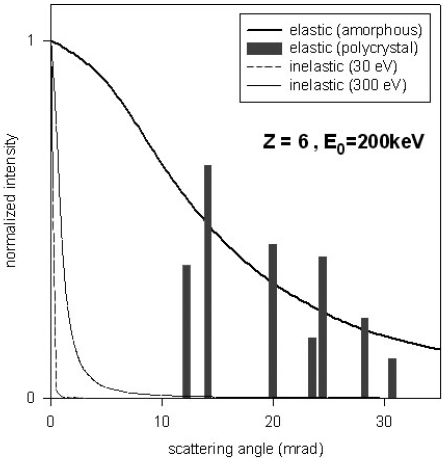
| As discussed in Section of Elastic Scattering of Incident Electron with an Atomic Nucleus, the crystalline specimen scatters electrons at discrete angles, named by Bragg angles. The elastic scattering is then called diffraction. However, because of atomic vibration, electrons can also undergo phonon scattering, broadening the angular width of each Bragg beam. The diffraction broadening, indicated by the width of the dark rods in Figure 4758, is due to an energy transfer of the order of kT (≈25 meV at T ≈ 300 K). This scattering, involving interaction with atomic nuclei by phonon is often termed quasi-elastic.
[1] Egerton, R. F., 2009. Electron energy-loss spectroscopy in the TEM, Rep. Prog. Phys. 72, 016502, 25.
|