Chapter/Index: Introduction | A |
B |
C |
D |
E |
F |
G |
H |
I |
J |
K |
L |
M |
N |
O |
P |
Q |
R |
S |
T |
U |
V |
W |
X |
Y |
Z |
Appendix
SEM Contrast Dependence on Surface Structure/Surface-topography Contrast
| SEs created at an inclined surface or close to a surface step have an increased probability of escape from the surface, resulting in surface-topography contrast [2].
Differences of energy and angular distributions of secondary electrons (SE) from reconstructed surfaces had been detected from SEs which had very low kinetic energy (normally ≤ 10 eV). For instance, SEs emitted from 7 x 7 - Si ( 111),  x - Ag and 5 x 2 - Au surfaces, excited by a 15 keV primary electron beam, had been measured in an ultrahigh-vacuum (UHV) chamber [1]. SE from 7 x 7 and x-Ag surfaces showed angular dependence nearly proportional to cos (Θ), described by Equation [4832], with Θ denoting the emission angle referred to surface normal: while those from 5 x 2-Au decrease more rapidly with 0. The latter can be explained by an additional field between the sample and the detector, resulting from the larger work function of 5 x 2-Au. x - Ag and 5 x 2 - Au surfaces, excited by a 15 keV primary electron beam, had been measured in an ultrahigh-vacuum (UHV) chamber [1]. SE from 7 x 7 and x-Ag surfaces showed angular dependence nearly proportional to cos (Θ), described by Equation [4832], with Θ denoting the emission angle referred to surface normal: while those from 5 x 2-Au decrease more rapidly with 0. The latter can be explained by an additional field between the sample and the detector, resulting from the larger work function of 5 x 2-Au.
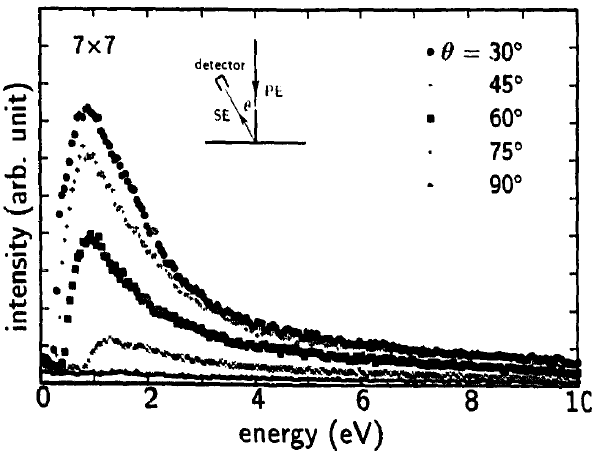
| Figure 4826 (a) Angular dependence of secondary electron (SE)
for surface of 7 x 7 Si( 111 ). Inset shows the experimental configuration. The primary electron (PE)
beam is incident normally to the surface. [1] |
[1] Akira Endo and Shozo Ino, Surface Science 346 (1996) 40-48.
[2] L. Reimer, Scanning Electron Microscopy, second edition, Springer, New York,
1998.
|