Chapter/Index: Introduction | A | B | C | D | E | F | G | H | I | J | K | L | M | N | O | P | Q | R | S | T | U | V | W | X | Y | Z | Appendix
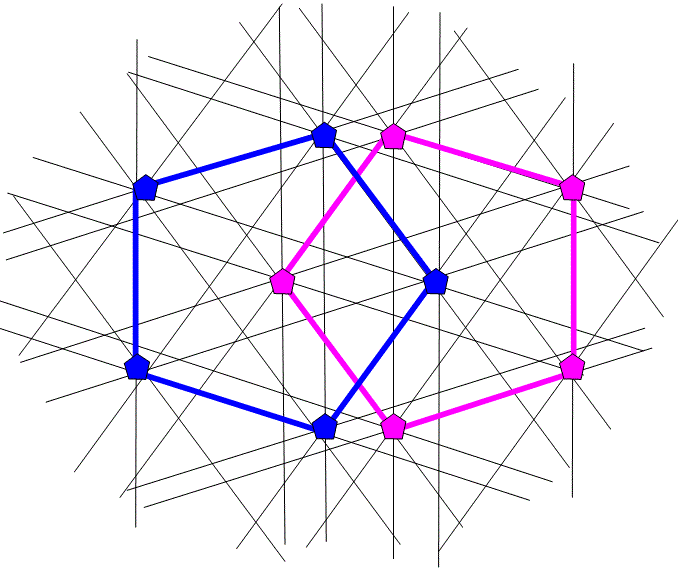
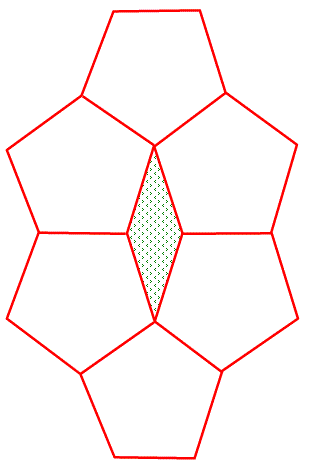
| Different from 4-fold and 6-fold rotational axes, two parallel 5-fold rotational axes cannot generate translational symmetry at the same distance of separation as in the original pair and thus no periodicity will result; therefore, they cannot coexist for 5-fold as shown in Figure 1458a.
Figure 1458a. Two parallel 5-fold rotational axes which do not generate translational symmetry. In reality, not all rotational symmetries are allowed in crystals. The only rotational symmetries possible in crystal lattices are 2, 3, 4 and 6, because it is impossible to fill space with other symmetries (e.g. 5, 7 …). However, quasi-crystals, e.g. with 5-fold rotational symmetry, can be formed.
Figure 1458b. Two-dimensional illustration of a quasi-crystal with 5-fold rotational symmetry. Note that the typical diffraction patterns of quasicrystals exhibit 5-fold or 10-fold rotational symmetry.
|