Chapter/Index: Introduction | A |
B |
C |
D |
E |
F |
G |
H |
I |
J |
K |
L |
M |
N |
O |
P |
Q |
R |
S |
T |
U |
V |
W |
X |
Y |
Z |
Appendix
Germanium (Ge)
| Germanium (Ge) surface normally has poor native oxides.
Table 2063a. Properties of germanium crystals.
Intrinsic resistivity ρi (Ωcm) |
46 |
Electron mobility µe (cm2V-1s-1) |
≤3900 |
Dielectric constant |
16.2 |
| Density at 300K (g/cm3) |
5.323 |
| Conduction band minimum |
L |
| Spin–orbit splitting (eV) |
0.296 |
| Effective masses of (100) electrons in longitudinal direction ml/m0 |
1.64 |
Electron drift
mobility µe
(m2V-1s-1) |
0.39 at 300 K |
| Static refractive index |
4.0 |
| Elastic constant (dyn cm-2) |
C11=12.6 ×10⁻¹¹ at 300 K; C12=4.4 ×10⁻¹¹ at 300 K; C44=6.77 ×10⁻¹¹ at 300 K |
| Raman spectra |
 |
Energy (band) gap Eg (eV) |
0.74 at 0 K; 0.66 at 300 K |
| Indirect bandgap (Eg,ind, eV) |
0.66 |
| Direct bandgap (Eg, dir, eV) |
0.80 |
Intrinsic carrier concentration ni (cm-3) |
2.0 x 10¹³ |
| Hole mobility µh (cm2V-1s-1) |
≤1900 |
| Heavy hole mass |
0.33 |
| Effective masses of heavy holes (mhh/m0) |
0.28 |
| Effective masses of light holes (mlh/m0) |
0.043 |
| Lattice constant (nm) |
0.5658 |
Interatomic distances in amorphous Ge (nm) |
0.244, 0.403, 0.602, 0.758 |
| Optical phonon energy (meV) |
37 |
| Energy gap at Γ (eV) |
0.80 |
| Electron affinity (eV) |
4.01 |
| Effective masses of (100) electrons in transverse direction (mt/m0) |
0.092 |
Hole drift
mobility µh
(m2V-1s-1) |
0.19 at 300 K |
| Radiative recombination coefficient (cm3s−1) |
6.4 × 10⁻¹⁴ |
| Melting temperature (K) |
1210 |
| Miscibility with Si |
Complete |
Table 2063b. Some surface energies (J/m2) of low-index surfaces of germanium crystals. The types of reconstructions are indicated. (1x1) relaxed denotes an unreconstructed cleavage surface.
Solid
|
(100)
|
(110)
|
(111) |
Ge |
1.0 c(4 × 4) |
1.17 (1 × 1) relaxed |
1.01 c(2 × 8) |
Figure 2063 shows the solubility for impurities (including Ge) in SiC.
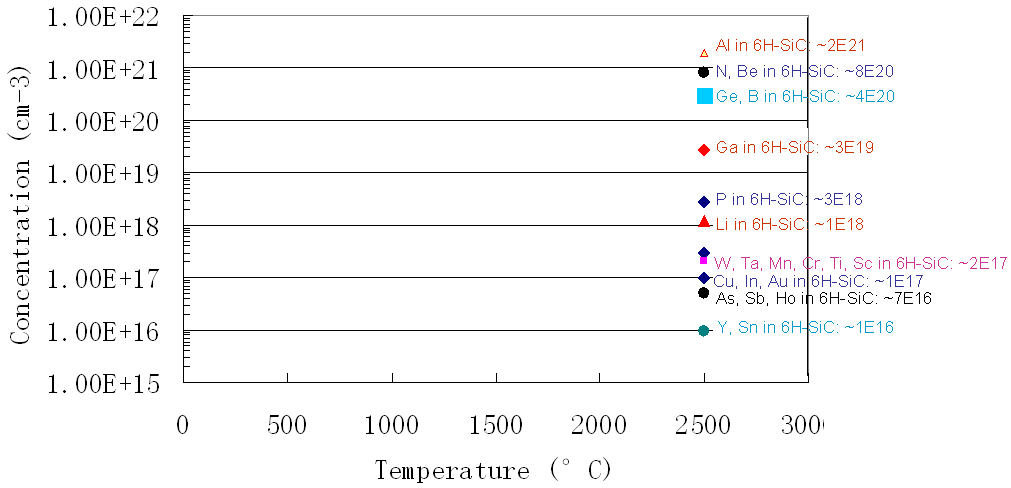
Figure 2063. Solubility for impurities in SiC.
|