Chapter/Index: Introduction | A | B | C | D | E | F | G | H | I | J | K | L | M | N | O | P | Q | R | S | T | U | V | W | X | Y | Z | Appendix
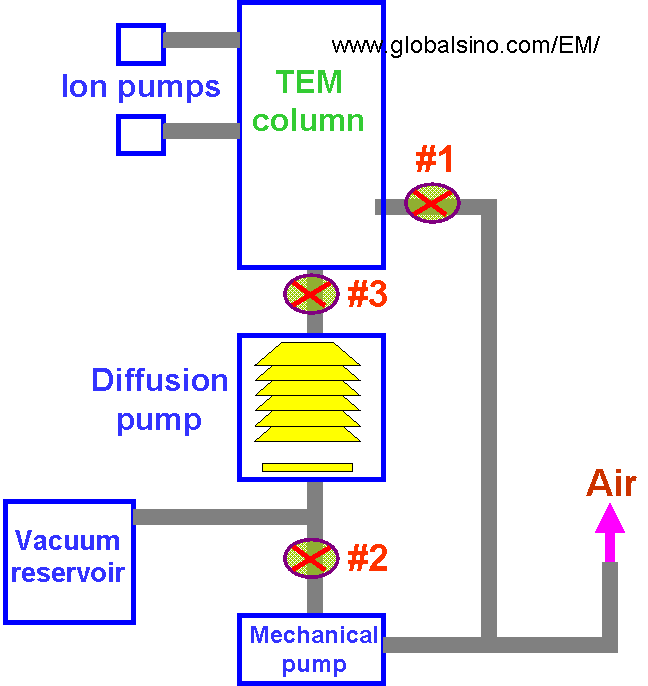
| When a vacuum pump is used to remove gas from another pump, then we can say the latter is ‘backed’ by the former. For instance, turbomolecular and oil-diffusion pumps in high vacuum systems, such as TEMs and SEMs, cannot work directly against atmospheric pressure and need a mechanical pre-vacuum pump in order to function as shown in Figure 4323. In these systems, the primary vacuum pumps, e.g. mechanical pump, can reach a vacuum of > 0.1 Pa, the secondary vacuum pumps such as oil diffusion pumps and turbomolecular pumps can reach a vacuum of <10-4 Pa, and the high and ultra-high vacuum pumps such as ion getter pumps and cold traps, in the gun and specimen areas, can reach a vacuum of < 10-6 Pa.
Figure 4323. Schematic illustration of pumping system in TEMs. There are various pumps for TEMs and SEMs, and one often has a choice when purchasing an instrument. However, a clean UHV system is very expensive.
|