
Chapter/Index: Introduction | A | B | C | D | E | F | G | H | I | J | K | L | M | N | O | P | Q | R | S | T | U | V | W | X | Y | Z | Appendix
| In Scanning Electron Microscopy (SEM), the working distance is the distance between specimen and lower pole piece of scanning electron microscope (SEM). The SEM contrast strongly depends on the working distance. The lower pole piece is the objective lens, which is the final lens of the electron column. For instance, at short working distance, the major contribution to the signal collected using the lateral detector is that of SE3 electrons, which are backscattered by the pole piece as shown in Figure 4843a. The corresponding contrast is a Z contrast.
The resolution and depth of field in a SEM are influenced by the working distance (WD). The depth of field (DOF) depends on both the working distance and the electron beam convergence angle (α). The approximate equation for DOF is given by:
Where:
Figure 4843b shows the DOF dependence on working distance for different beam convergence angles.
The working distance can be selected depending on the application, the type of sample, and the resolution required, but here are the typical ranges:
Therefore, choosing the working distance depends on the trade-off between resolution and depth of field. A shorter working distance enhances resolution but reduces the depth of field, while a longer working distance increases the depth of field but decreases resolution.
|
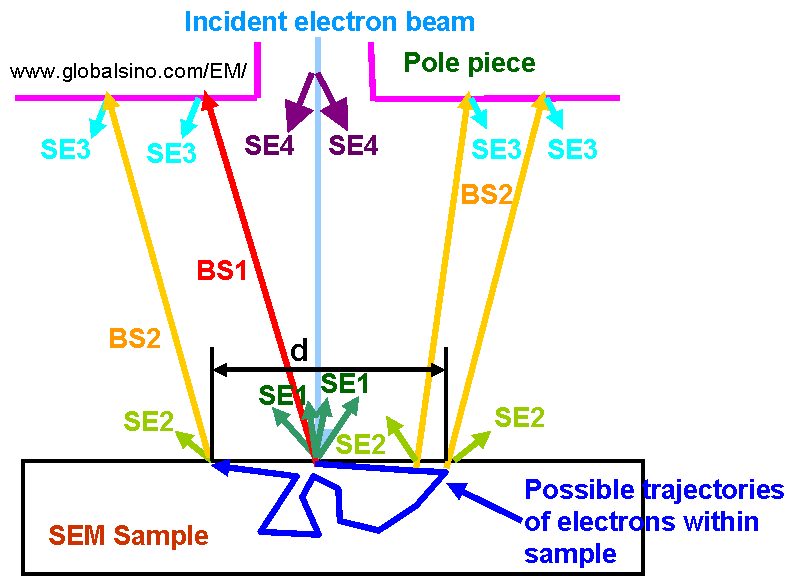
 -------------------------------------------------------- [4843a]