Chapter/Index: Introduction | A | B | C | D | E | F | G | H | I | J | K | L | M | N | O | P | Q | R | S | T | U | V | W | X | Y | Z | Appendix
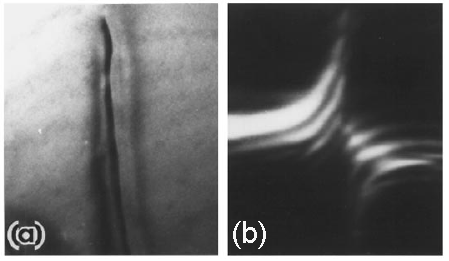
| In principle, for CBED the largest obtainable convergence angle is used to observe as much structure as possible within the CBED disks. To draw an unambiguous conclusion about Burgers vectors, in many cases a combination of different techniques is applied. For instance, LACBED (large angle convergent beam electron diffraction) can provide more information on the properties of Burgers vectors. It had been suggested that when a LACBED Bragg line intersects a dislocation, displacement and splitting of the Bragg line may occur [1], from which the sign and magnitude of b can be obtained. [2 - 4] This method is called Cherns–Preston rules. These rules give the magnitude of b by g·b = m+1, where m is the number of subsidiary maxima in between the main peaks obtained in a dark-field image. For instance, Figure 1998 shows the dark-field contour of D1, taken by g = [0006], has m = 5 corresponding to g·b = 6. After applying the rules for the sign of b, [5] the Burgers vector is given by b = - c = [000-1] as listed in Table 3463. Note that the intensity and position of the subsidiary fringes vary with the dislocation character and depth in the TEM sample.
Figure 1998. (a) Bright field image and (b) Dark-field LACBED pattern
|