Chapter/Index: Introduction | A | B | C | D | E | F | G | H | I | J | K | L | M | N | O | P | Q | R | S | T | U | V | W | X | Y | Z | Appendix
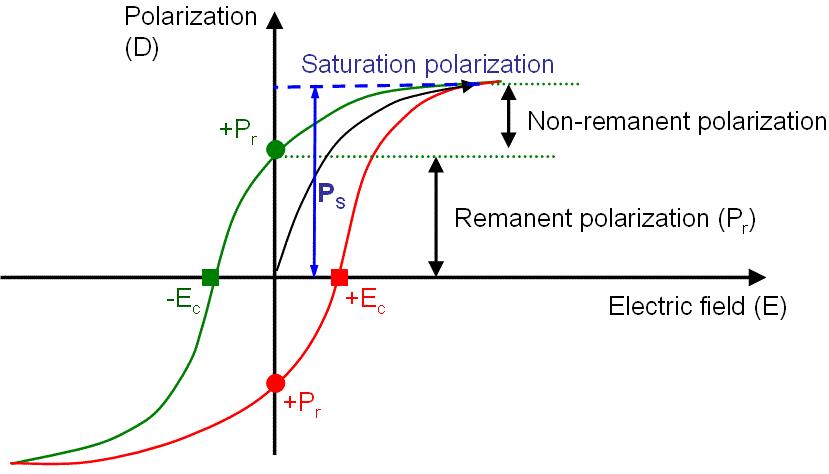
| A crystal possesses a spontaneous polarization (Ps) if the centers of the positive and negative charges in the crystal structure do not coincide naturally. Spontaneous polarization can be quantified by the value of electrical dipole moments per unit volume in units of C-m/m3. Ferroelectric substances normally present separate regions called domains that have different spontaneous polarization directions. The number of distinct spontaneous polarization directions depends on its point group symmetry. Moreover, the rotation of polarization is accompanied by a change of crystal orientation and/or symmetry. The spontaneous polarization in ferroelectrics has two or more orientational states and may be switched from one state to the other by an external electric field, or in some cases, by a mechanical stress. The ability to switch the polarization depends on the experimental conditions and the material properties (e.g. crystalline perfection and electrical conductivity). One classification method of ferroelectric substances is based on the number of directions allowed to spontaneous polarization: The comparison between the pyroelectrics and ferroelectrics is: Figure 2380 shows a typical polarization versus electric field loop of a ferroelectric material.
|