Chapter/Index: Introduction | A | B | C | D | E | F | G | H | I | J | K | L | M | N | O | P | Q | R | S | T | U | V | W | X | Y | Z | Appendix
| Silicon carbide (SiC) was first discovered in 1823 by Jons Jakob Berzelius at the Karolinska Institute in Stockholm [2]. Crystalline SiC has structures of tetrahedrally coordinated lattice. SiC can form various crystalline structures based on its stacking sequence, a characteristic known as polytypism, with each unique structure referred to as a SiC polytype. As a classical polytypic material, SiC exists in over 250 distinct polytypes [3, 4]. The atomic layers can stack in cubic (C), hexagonal (H),or rhombohedral (R) configurations. These structures are labeled by the symmetry (C, H, or R) following the number of the layers in one period of the stacking sequence. Among these, the 6H-SiC, 4H-SiC, and 3C-SiC polytypes are the most commonly studied for device applications. Figure 2089a illustrates the crystal structures of the 4H, 6H, and 3C SiC polytypes [5]. 3C is equivalent to the zincblende structure, while 2H is the wurtzite structure. The most common commercially available form is 6H-SiC (Table 2089a).
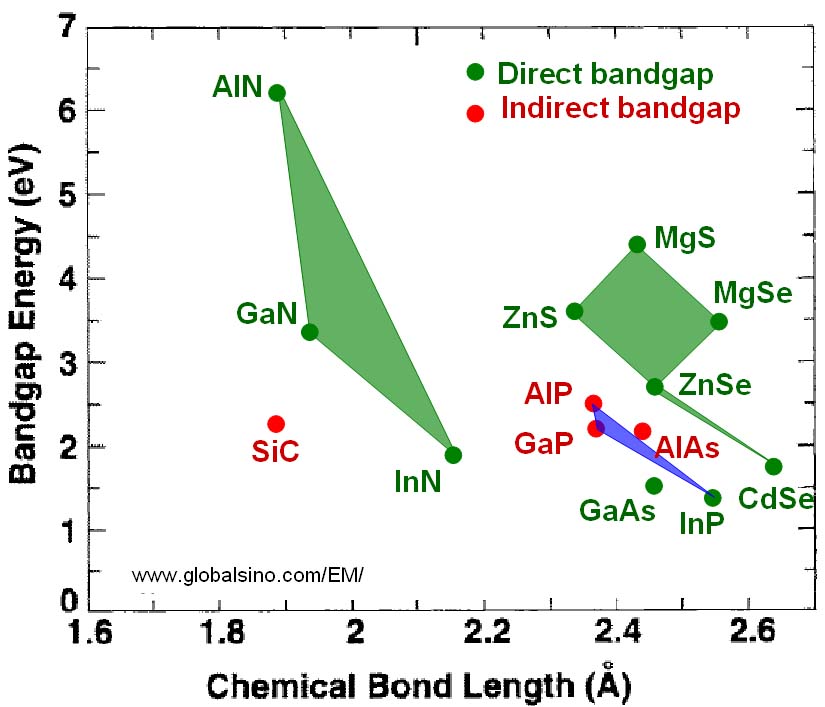
Figure 2089b shows bandgap and chemical bond length for semiconductors used in visible LEDs (light emitting devices).
Figure 2089b. Bandgap and chemical bond length for semiconductors used in visible LEDs (light emitting devices). Adapted from [1] Table 2089a shows the lattice properties of 6H-SiC. Table 2089a. Comparison of properties of crystalline and amorphous SiC materials.
Table 2089b shows the lattice mismatch (%) between the substrates and epitaxial layers, and the resulting misfit dislocation separation (in Å) corresponding to complete misfit relaxation for the basal plane interfaces. Table 2089b. The lattice mismatch (%) between the substrate and epitaxial layers, and the resulting misfit dislocation separation (in Å).
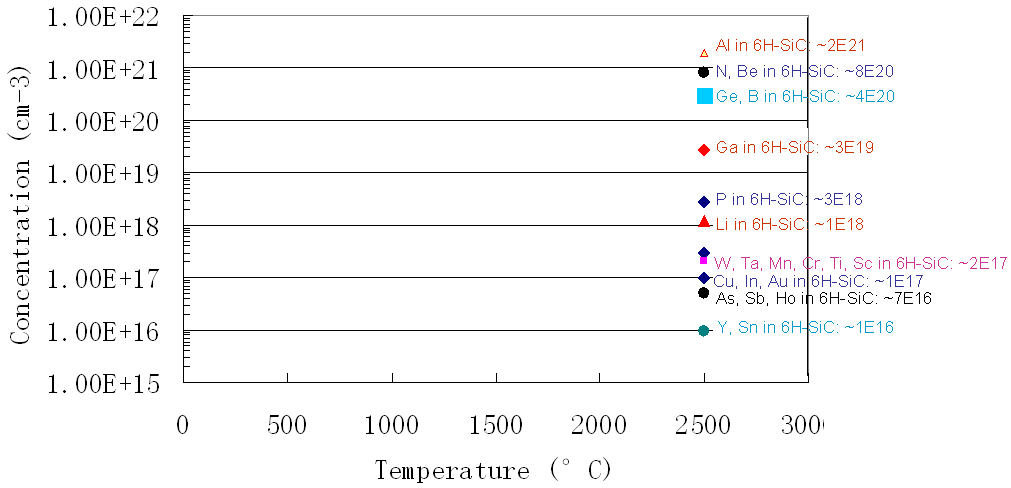
Note that SiC normally has poor native oxides. Figure 2089c shows the solubility for impurities in SiC.
Figure 2089c. Solubility for impurities in SiC.
[1] Ponce, F. A. and Bour, D.P., Nature, 386, (1997) 351.
|