Chapter/Index: Introduction | A | B | C | D | E | F | G | H | I | J | K | L | M | N | O | P | Q | R | S | T | U | V | W | X | Y | Z | Appendix
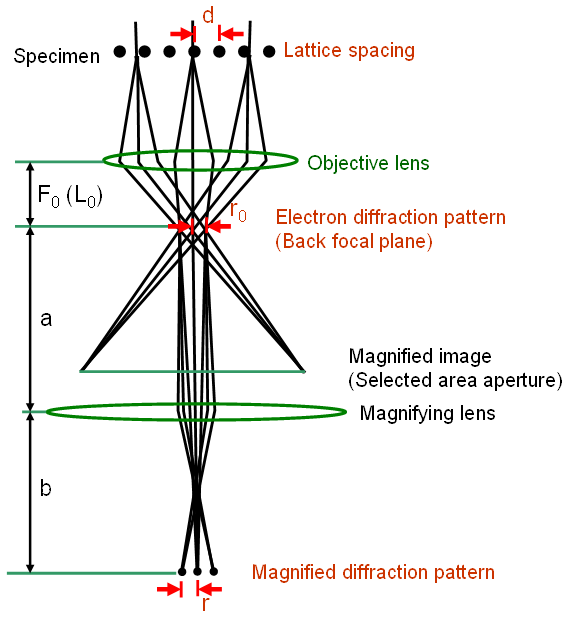
| If no magnetic lens is used, the camera length is defined as the distance from the specimen to the recording plane (e.g. film or CCD camera). Because some lenses are used in a TEM, the actual camera length should be the effective camera length. With a parallel electron beam, the camera length L0 is equal to the focal length f0 of the objective lens as shown in Figure 3245. Due to the effect of magnifying lens (magnified from r0 to r), the camera length is modified. By considering that the magnifying lens system magnifies the pattern and projects it onto the recording plane at magnification M (M=b/a), the final, effective cameral length L should be given by, L = L0 · M --------------------------------- [3245] However, for convenience, the effective camera length traditionally is just called a “camera length”.
To have a camera length exactly as labeled in the instrument, some key points need to be satisfied as follows: Note that the magnification and camera length projected on the fluorescent screen are slightly smaller than the ones on the film because the fluorescent screen is located at a higher position than the film.
|