Chapter/Index: Introduction | A | B | C | D | E | F | G | H | I | J | K | L | M | N | O | P | Q | R | S | T | U | V | W | X | Y | Z | Appendix
|
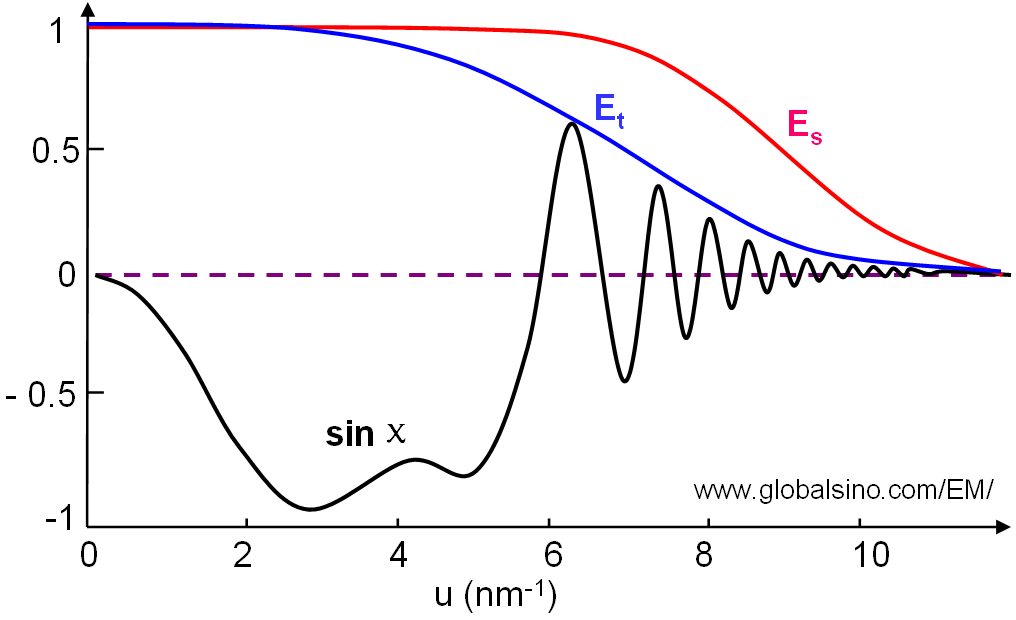
In EMs (especially in TEMs), the temporal coherency effects comes from the small instabilities in the accelerating voltage and electron gun emission over time, which will give the illumination a small energy spread, and from variations in the lens currents, which induces focus variation with time. Because the electrons with different energy are also focused at different planes, the total effect of the temporal coherency variations is to create a defocus spread (usually in the order of a few nm). Therefore, the temporal-coherence envelope function Et(|g|) is a term affecting the contrast transfer fuction and depends on the chromatic aberration of the objective lens, the energy spread of the illuminating beam, and the current instability of the objective lens. Et(|g|) is given by, where, This defocus spread (Δ) is the spread mainly caused by the current instability (δI/I0) of the objective lens, the overall energy spread of the incident electron beam (δV/V0), and the incident electron energy (δE/E0). Δ is given by, where, Information limit depends on the damping envelope incorporating partial temporal coherence due to chromatic aberration, but not partial spatial coherence due to beam convergence. Figure 4165 shows the separate effects of the temporal (Et) and spatial (Es) coherence envelopes on the phase contrast transfer function.
Figure 4165. The effects of the temporal (Et) and spatial (Es) coherence envelopes on the phase contrast transfer function.
|
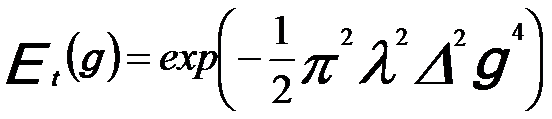 ------------------------------ [4165a]
 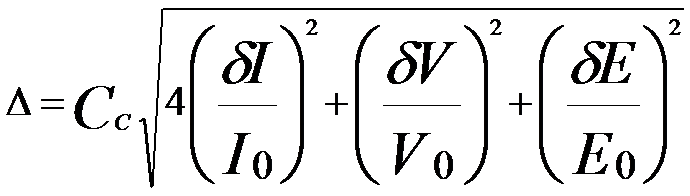 ------------------------------ [4165b]